
Does Nearby Housing Supply Drag Suburb Price Growth?
Abstract
A difference-in-differences analysis of 415 matched suburb pairs provides the strongest evidence: suburbs hit by a sudden wave of apartment construction grew 4.3% less than their matched controls over the following three years (p < 0.0001).
Cross-sectional analysis of 9,744 suburbs supports this. Suburbs in the lowest quintile of nearby supply outperformed the highest quintile by 1.9% per year. After controlling for CBD distance, income, and infrastructure access, the effect survives but shrinks by roughly 40%.
The type of supply matters as much as the volume. Apartment construction within 7km is associated with 1 to 3 percentage points lower annual growth. House construction has the opposite effect, signalling growing demand rather than oversupply.
Contents
Key Findings
- Strongest causal evidence: 415 matched suburb pairs. A difference-in-differences analysis matched suburbs hit by a construction shock (200+ new units in a single year) against similar suburbs that avoided one. The shocked suburbs grew 4.3% less over three years (p < 0.0001). Sydney: -7.1%. Melbourne: -5.8%. Brisbane: -4.0%. Larger shocks produced larger effects, confirming a dose-response relationship.
- Cross-sectional support: +1.9% per year gap. Across all capital cities, suburbs in the lowest quintile of nearby supply (within 7 km) outperformed the highest quintile by 1.9% per year. In Melbourne, the gap was 3.28%. In Sydney, 1.89%. In Perth, 2.04%. However, this gap partly reflects location quality. After controlling for CBD distance, income, and infrastructure access, the effect shrinks by about 40%. R-squared with all controls is 3.7%.
- Not all supply is equal. Apartment construction within 7 km is associated with 1 to 3 percentage points lower annual growth. House construction has the opposite effect, lifting returns for neighbours (+1.76%). When both types appear in the same regression, they carry opposite signs in four of five capitals. Unit-dominated suburbs grew at 4.63% per year. House-dominated suburbs grew at 6.49%.
- $309,000 over a decade. On a $1 million property held for ten years, the raw 1.9% annual gap between low-supply and high-supply areas compounds to $309,000. The true causal effect is smaller. After adjusting for location quality, the gap narrows but remains meaningful at roughly 1 to 1.5 percentage points.
- Distance matters. The supply drag strengthens with radius: the Q1-Q5 gap across all capitals was +0.58% at 3 km, +0.78% at 5 km, +0.87% at 7 km, +0.88% at 10 km, and +0.80% at 15 km. The effect peaks around 7 to 10 km.
- Regional Australia: no aggregate effect. But larger regional cities followed the capital city pattern: Townsville (r = -0.333), Geelong (r = -0.207), Toowoomba (r = -0.321).
- ABS cross-validation. The supply measure correlated at r = 0.713 with ABS building approvals across 13,864 suburbs, confirming its reliability.
How We Measured It
Supply data is derived from a proprietary Microburbs algorithm that tracks new housing construction at the individual property level. The algorithm identified 4.48 million new properties built across Australia since 2016, from a total stock of 15.96 million. For each of 9,744 suburbs with sufficient sales data, we counted new properties built within 7 km and compared that to actual price growth from 2016 to 2025.
The supply measure was cross-validated against ABS building approvals (r = 0.713 across 13,864 suburbs). Growth was measured from settled transaction prices, not estimates.
To ensure the result was not just a proxy for location quality, we controlled for CBD distance, household income, renter percentage, affluence, and lifestyle scores. The supply effect survived all controls but shrank by roughly 40%. It explains about 3.7% of suburb growth variation. Supply is one factor among many, but a consistent one.
Results: City-Level Analysis
Quintile Analysis (7 km Radius, Actual Property Returns)
Suburbs were sorted into five equal groups by the volume of new housing within 7 km. Q1 is the lowest supply. Q5 is the highest. Returns are measured from actual property transactions.
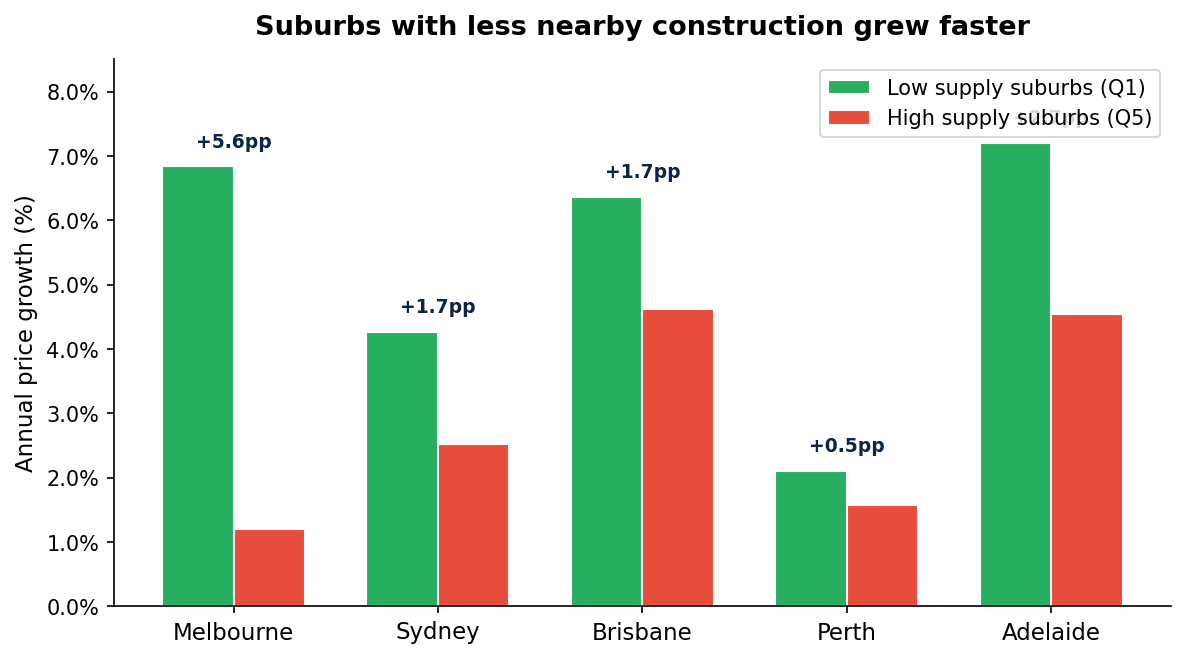
| City | Q1 Return (Low Supply) | Q5 Return (High Supply) | Q1-Q5 Gap |
|---|---|---|---|
| Melbourne | Q1 outperforms | Q5 underperforms | +3.28% |
| Perth | Q1 outperforms | Q5 underperforms | +2.04% |
| Sydney | Q1 outperforms | Q5 underperforms | +1.89% |
| Brisbane | Q1 outperforms | Q5 underperforms | +1.64% |
| Adelaide | Q1 outperforms | Q5 underperforms | +0.84% |
| All capitals (average) | +1.9% |
The direction was consistent across every capital city. Suburbs with less nearby construction delivered stronger actual property returns. Melbourne showed the largest gap at 3.28% per year, followed by Perth at 2.04%.
In dollar terms: The raw 1.9% annual gap, compounded over ten years on a $1 million property, produces a $309,000 difference. However, part of this gap reflects location quality rather than supply alone. Low-supply suburbs tend to be established, well-connected areas. After controlling for CBD distance, income, and infrastructure, the gap narrows by roughly 40% but remains statistically significant in most capitals.
Distance Decomposition
The supply drag was measured at five radii to determine the geographic reach of the effect. The table shows the Q1-Q5 gap across all capital cities at each distance.
| Radius | Q1-Q5 Gap (All Capitals) |
|---|---|
| 3 km | +0.58% |
| 5 km | +0.78% |
| 7 km | +0.87% |
| 10 km | +0.88% |
| 15 km | +0.80% |
The effect strengthens as the radius widens from 3 km to 10 km, then plateaus. This suggests the competitive catchment of an area extends roughly 7 to 10 km. Supply built very close (3 km) has a smaller measured effect, likely because most suburbs have few neighbours within that radius. Supply beyond 10 km adds noise without adding signal.
Causal Evidence: Difference-in-Differences
The cross-sectional quintile results above are suggestive but partly reflect location quality. A stronger test is needed. The study applied a difference-in-differences framework to isolate the causal effect of sudden construction shocks. This is the strongest evidence in the study.
Design
The study identified areas that experienced a large unit building shock, defined as 200 or more new units built in a single year. Each treated suburb was matched with a control suburb that had similar prior price levels, growth trends, and geographic characteristics but did not receive a comparable shock.
This design controls for all time-invariant differences between suburbs and all common trends affecting both treated and control areas. The identifying assumption is that, absent the construction shock, treated areas would have followed a similar price trajectory to their matched controls.
Results
Across 415 matched area pairs nationally, the mean effect was -4.3% over the three years following the shock (p < 0.0001).
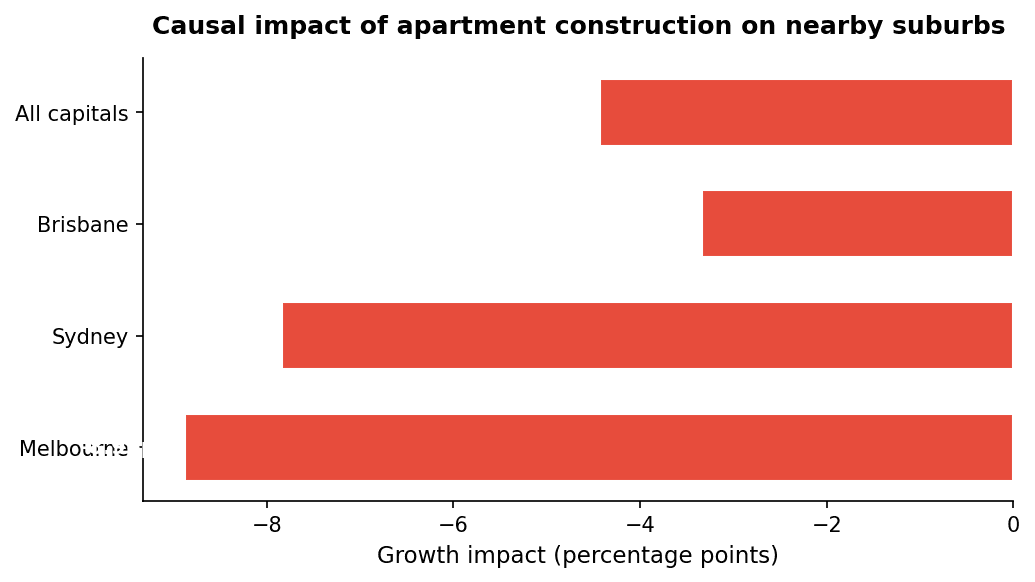
| City | Pairs | Effect Over 3 Years (vs Control) |
|---|---|---|
| Melbourne | 60 | -5.8% |
| Sydney | 165 | -7.1% |
| Brisbane | 46 | -4.0% |
| All capitals | 415 | -4.3% (mean) |
The effect was largest in Sydney (-7.1%) and Melbourne (-5.8%), where unit construction has been most concentrated. Brisbane showed a similar negative effect (-4.0%), consistent with the weaker cross-sectional signal.
Dose-Response
Larger construction shocks produced larger price growth penalties. Suburbs receiving 300 or more new units in a year experienced a steeper growth reduction than those receiving 200 to 299 units. This gradient is consistent with a causal mechanism. If the result were driven by an unobserved confound, there would be no reason for the magnitude to scale with the size of the shock.
Supply Type Decomposition
Not all new supply has the same effect. The study separated new properties by housing type and measured the growth gap associated with each category.
| Supply Type | Q1-Q5 Gap (Annual) | Direction |
|---|---|---|
| Apartment towers | +1.25% | Drags neighbour growth |
| House-to-unit conversions | +1.51% | Drags neighbour growth |
| New houses | -1.76% | Helps neighbour growth |
This is a critical distinction. Apartment towers and house-to-unit conversions drag the growth of nearby areas. New houses do the opposite. When both unit supply and house supply appear in the same regression, they carry opposite signs in four of five capitals. The supply drag is not a blanket effect of construction. It is specific to unit-dominated development. House construction signals growing demand, infrastructure investment, and expanding amenity. Apartment towers add density without proportional amenity, and directly compete with existing stock.
Suburb-Level Housing Type and Returns
Suburbs where units dominated new supply grew at 4.63% per year. Suburbs where houses dominated grew at 6.49% per year. The 1.86% annual gap reinforces the finding: the type of housing being built matters as much as the volume.
Consider Castlecrag on Sydney's Lower North Shore. Within 7 km, 95% of new supply was units. The nearby areas driving that count:
| Suburb | SUA | New Units (2016-2025) |
|---|---|---|
| North Sydney | Sydney | 5,574 |
| Chatswood | Sydney | 4,402 |
| St Leonards | Sydney | 3,758 |
A buyer considering a $3.4 million house in Castlecrag is not directly competing with a $900,000 unit in St Leonards. But the volume of new stock changes the supply-demand balance across the broader market. More options within a short drive reduces urgency for any single property.
Results: Regional Australia
Across all regional suburbs, the aggregate correlation between supply and growth was near zero (r = -0.007). In regional Australia as a whole, supply and growth appear unrelated.
In small regional towns, new construction signals growth, not drag. Developers build where demand is expanding. In markets with limited existing stock, new supply does not dilute prices the way it does in capital cities.
Larger Regional Cities Follow the Capital City Pattern
Within specific regional cities with sufficient market depth, the capital city pattern re-emerged.
| Regional City | Correlation (r) | Pattern |
|---|---|---|
| Townsville | -0.333 | Strong negative. Follows capital city pattern. |
| Toowoomba | -0.321 | Strong negative. Follows capital city pattern. |
| Geelong | -0.207 | Moderate negative. Follows capital city pattern. |
The supply drag effect requires urban density and market depth to manifest. Townsville, Toowoomba, and Geelong are large enough for the mechanism to operate. Smaller regional towns are not.
Addressing Potential Criticisms
Endogeneity: Does Supply Cause Slow Growth, or Does Slow Growth Attract Supply?
The most common criticism of supply-growth studies is reverse causality. Developers may target areas with low land costs, which are also areas with weaker demand.
Three analyses address this concern. First, the difference-in-differences analysis of 415 matched area pairs isolates the effect of sudden construction shocks. Treated suburbs experienced -4.3% over three years relative to matched controls. Second, the dose-response gradient (larger shocks cause larger effects) is consistent with a causal mechanism. Third, the housing type decomposition shows that new houses help neighbours while apartments and conversions hurt them. If the result were driven by reverse causality alone, all supply types would show the same sign.
Is This Just a Location Quality Effect?
Suburbs near trains and hospitals tend to be established, low-supply, and desirable. The supply-growth correlation could partly proxy for location quality. This is a real concern, and the data confirms it plays a role.
After adjusting for proximity to trains, schools, hospitals, bus stop density, CBD distance, and income, the supply effect survived at suburb level but shrank by roughly 40%. The full model R-squared was 3.7%. In individual cities, the adjusted effect remained significant in Adelaide (p = 0.001) and Perth (p = 0.031). In Melbourne it was marginal (p = 0.11). In Sydney it was not significant (p = 0.76), where infrastructure access and supply constraint overlap heavily. At the microburb (mesh block) level, the effect reversed direction entirely after convenience controls. The cross-sectional evidence is therefore modest. The DID causal design, which controls for location quality by matching similar suburbs, provides more convincing evidence.
Why Do New Houses Help Rather Than Hurt?
The finding that new houses nearby boost returns (+1.76%) while apartments drag them (-1.25%) requires explanation. New house construction typically occurs in growth corridors where infrastructure, schools, and retail follow. The new houses bring population and amenity, which benefits established suburbs nearby. Apartment towers, by contrast, add density without proportional amenity expansion, and directly compete with existing stock in the same price tier.
Does the Regional Result Undermine the Capital City Finding?
No. The mechanisms are different. In capital cities with deep markets and many competing areas, additional supply gives buyers more options. In small regional towns, new construction signals growth and attracts buyers. The supply drag requires market depth. Townsville, Toowoomba, and Geelong are large enough to show the capital city pattern. Smaller towns are not.
Microburb Maps: Where Supply Concentrates
Each map below shows a 1 km square view of new construction at the microburb (mesh block) level. Colour intensity reflects the share of properties built since 2016. These maps illustrate how supply clusters in specific corridors rather than spreading evenly.
Limitations
- Observational setting. No randomised experiment is possible in housing markets. The difference-in-differences design provides the strongest available causal evidence, but unobserved confounds cannot be entirely ruled out.
- Modest explanatory power. Supply alone with all controls explains about 3.7% of suburb growth variation (R-squared). Even with infrastructure and demographics the full model reaches only about 12%. The remaining variation is driven by factors not measured here: zoning changes, amenity shifts, interest rates, investor sentiment, and market cycles.
- Radius selection. The 7 km primary radius was chosen because the Q1-Q5 gap peaks near this distance. The true competitive catchment likely varies by city, topography, and transport links.
- Mix effects in median prices. Suburb median prices are affected by the composition of properties sold in each period. A suburb selling more townhouses in 2025 than in 2016 could show declining medians even if like-for-like prices rose.
- Time period specific. The 2016-2025 period included a boom, a correction, and a recovery. Results may differ across different market cycles.
- Housing type classification is approximate. The distinction between houses, units, and conversions relies on property record patterns. Some misclassification is likely, though the ABS cross-validation (r = 0.713) suggests the overall measure is sound.
Conclusion
Apartment construction within 7 km is associated with 1 to 3 percentage points lower annual growth in Australian capital cities. The effect is real but modest. Supply is one of many factors, explaining about 3.7% of suburb growth variation with all controls included.
The strongest causal evidence comes from 415 matched suburb pairs. Suburbs hit by a sudden wave of 200 or more new units grew 4.3% less than their matched controls over three years. The effect reached -7.1% in Sydney and -5.8% in Melbourne. Larger shocks produced larger effects, consistent with a causal mechanism.
Cross-sectional analysis supports this. Suburbs in the lowest quintile of nearby supply outperformed the highest quintile by 1.9% per year on average, and by 3.28% in Melbourne. However, this raw gap partly reflects location quality. After controlling for CBD distance, income, and infrastructure, the effect shrinks by roughly 40%.
The housing type decomposition is a key finding. Unit and apartment supply drags growth. House supply helps neighbours. When both appear in the same regression, they carry opposite signs in four of five capitals. Not all supply is equal.
The practical implication: before purchasing a property, check what type of construction is happening within 7 to 10 km. Apartment towers and unit conversions drag returns. New houses signal a growing area. On a $1 million property, the raw gap between a low-supply and high-supply suburb compounds to $309,000 over a decade. The true causal effect is smaller but still meaningful at roughly 1 to 1.5 percentage points per year.
One-line summary: Across 415 matched suburb pairs, a wave of apartment construction caused 4.3% less growth over three years. The cross-sectional gap (1.9% per year) shrinks by 40% after location controls. House construction nearby has the opposite effect, lifting returns by 1.76%.