
What Does the Median Australian Property Investor Actually Earn?
40,700 real house transactions. Every cost included. The median return is 5.5% per year. But the spread tells a far bigger story.
February 2026

Executive Summary
The median Australian property investor earns 5.5% per year after every cost is deducted. That includes stamp duty, mortgage interest, agent fees, capital gains tax, and maintenance. Out of 40,700 house transactions tracked from 2002 to 2025, 86% of investors made a profit. And 64% beat a 4% term deposit.
But the median hides everything interesting. The top 10% of investors earned above 13.6% per year. The bottom 10% lost money, returning below -1.5% annually. Same country. Same time period. That gap is the real finding of this study.
The Median Hides Everything
When someone tells you property returns 5.5% per year, what does that actually mean? It means half of investors did better and half did worse. It says nothing about how much better or worse.
Here is what the distribution actually looks like.
The spread between the top 10% and bottom 10% is more than 15 percentage points per year.
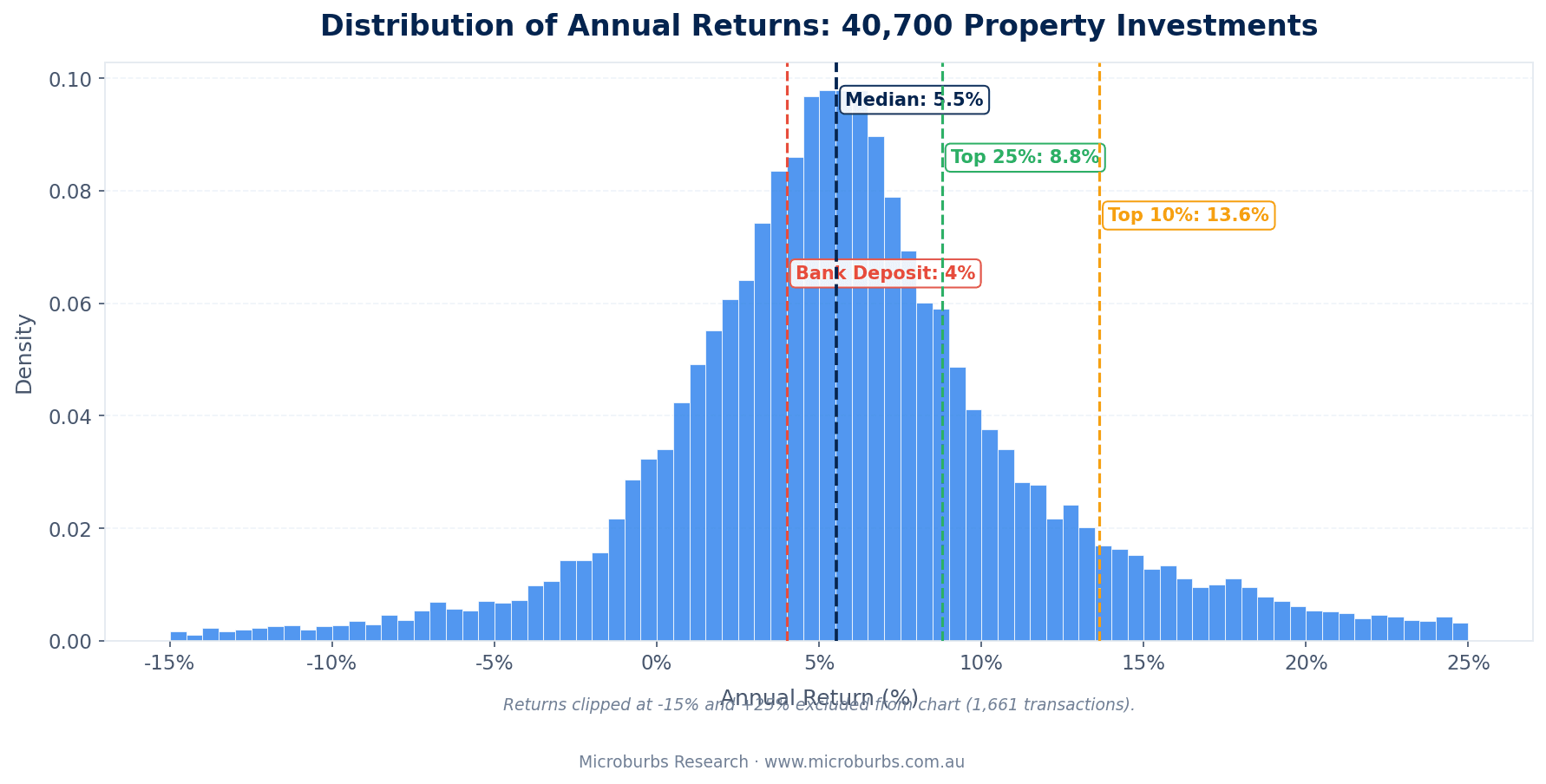
The top 25% of investors earned above 8.8% per year. That comfortably beats the long-run return of Australian equities. The bottom 25% earned below 2.4%. Worse than a savings account.
And the bottom 10% went backwards. Below -1.5% per year. They bought a house, held it, paid all the costs, and ended up with less money than they started with.
The key insight:
There is no single 'property return'. There is a distribution. Where you land in that distribution depends on what you buy, where you buy, and how long you hold.
Think of it like rainfall. Someone tells you Australia gets 534mm of rain per year on average. That number is true and completely useless. Darwin gets 1,700mm. Alice Springs gets 280mm. The average describes nowhere.
Property returns work the same way. The median of 5.5% describes almost nobody's actual experience. Some investors in Elizabeth North, SA bought houses at a median of $154,000 and earned 12.2% per year. Some investors in Greater Darwin earned 0.7%. Same asset class. Same country.
The distribution at a glance
64% of investors beat a 4% bank deposit. That is a majority, but not an overwhelming one. And only 30% beat an 8% equity benchmark. Property is not the guaranteed wealth builder that the industry sells. It can be. But it depends entirely on execution.
The Convergence Funnel
How long you hold changes everything. Not just the median return, but the entire shape of the distribution.
Look at what happens to the spread between the 10th and 90th percentile as the hold period extends.
The range of outcomes narrows dramatically with time. Short holds are a coin flip. Long holds converge.
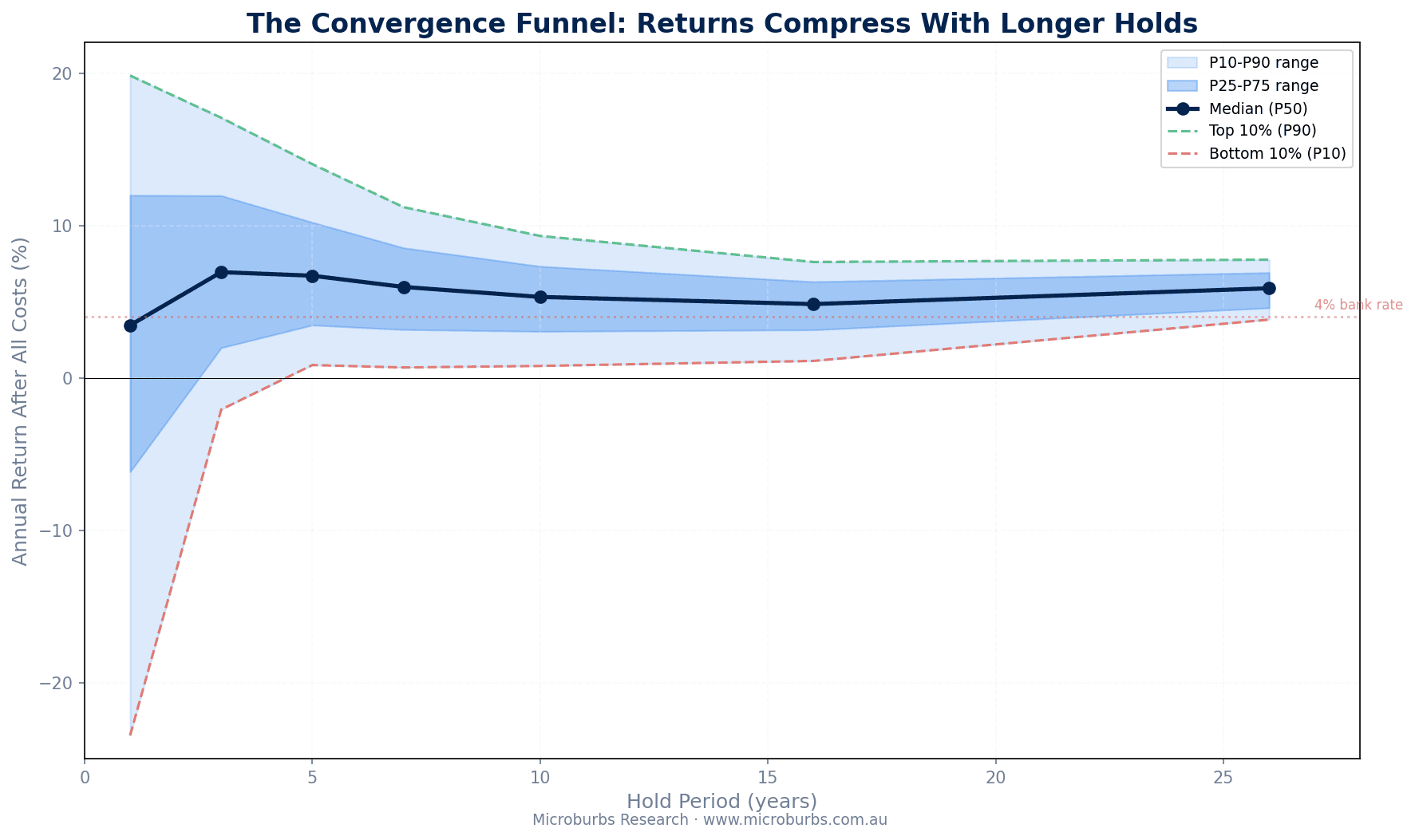
For investors who held 0 to 2 years, the interquartile range spans 18.2 percentage points. The top 10% earned 19.8% per year. The bottom 10% lost 23.5% per year. That is a 43-point spread between the winners and losers.
For investors who held 20 years or more, the interquartile range shrinks to 2.3 points. Every single one of them made a profit. The worst performer among them still earned 3.8% per year.
Think of it like this:
Flipping a house is like picking a single card from the deck. You might draw an ace. You might draw a two. Hold for 20 years and the hand averages out. The longer the game, the more the odds work in your favour.
Full breakdown by hold period
| Hold Period | P10 | P25 | Median | P75 | P90 | Profit % | n |
|---|---|---|---|---|---|---|---|
| 0-2 years | -23.5% | -6.2% | 3.5% | 12.0% | 19.8% | 61% | 6,522 |
| 2-4 years | -2.1% | 2.0% | 6.9% | 12.0% | 17.1% | 83% | 8,350 |
| 4-6 years | 0.8% | 3.5% | 6.7% | 10.2% | 14.0% | 93% | 6,381 |
| 6-8 years | 0.7% | 3.2% | 6.0% | 8.5% | 11.2% | 92% | 5,162 |
| 8-12 years | 0.8% | 3.0% | 5.3% | 7.3% | 9.3% | 93% | 7,143 |
| 12-20 years | 1.1% | 3.1% | 4.8% | 6.3% | 7.6% | 95% | 7,055 |
| 20+ years | 3.8% | 4.6% | 5.9% | 6.9% | 7.8% | 100% | 87 |
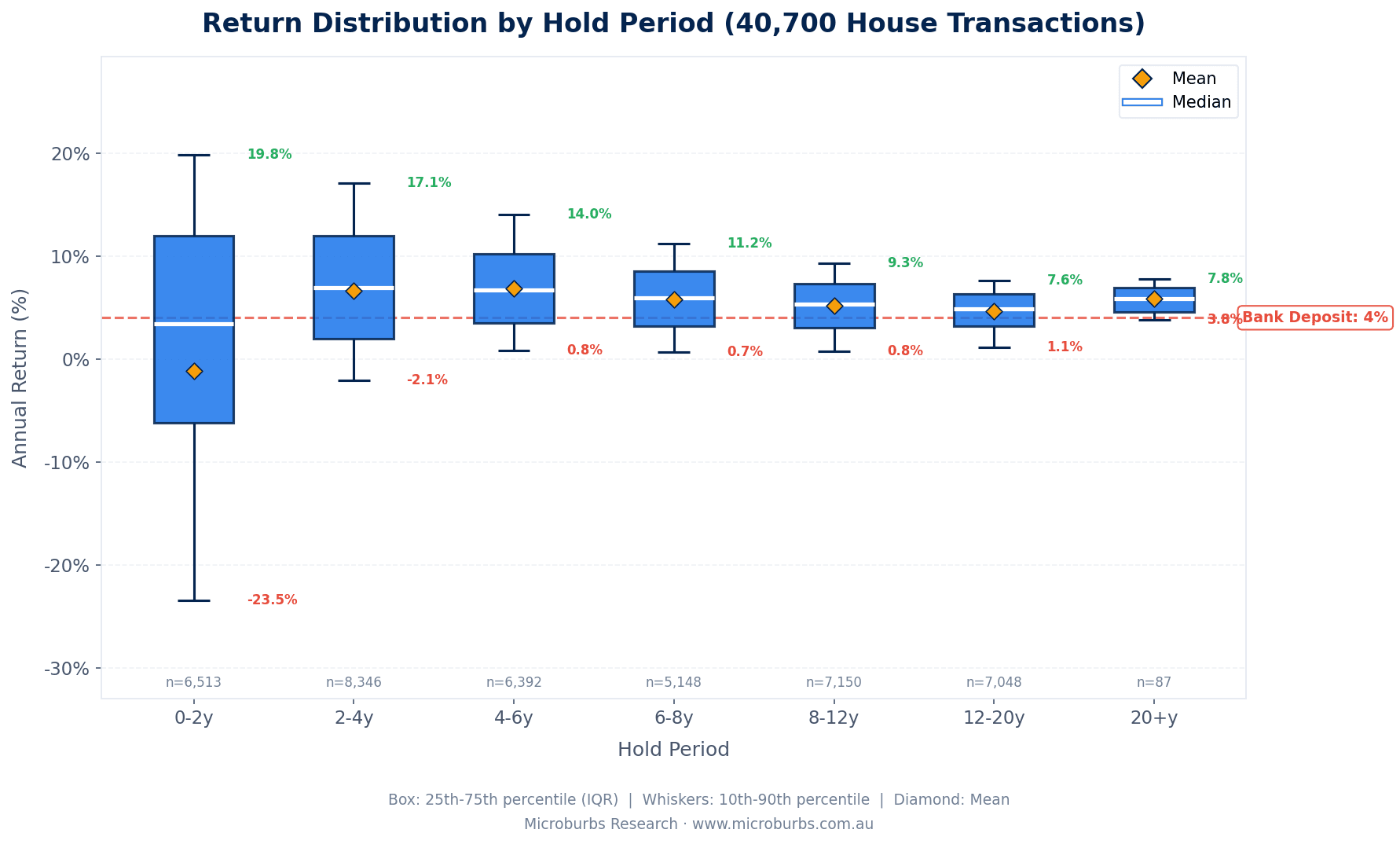
The pattern is clear. Short holds have higher upside and devastating downside. The 2-4 year bracket has the highest median at 6.9%, but its bottom 10% still lose money. Hold for 12 to 20 years and the median drops to 4.8%, but the worst case is still positive at 1.1%.
Time does not increase the median return. It compresses the variance. That is a different thing entirely, and most investors do not understand the difference.
Who Are the Top 10%?
What separates the top performers from the rest? Start with the short-term winners. Investors who held for 1 to 4 years and landed in the top tier.
The top 10% of short-term holders earned above 18.1% per year. The top 25% earned above 12.4%. The median short-term holder earned 6.6%. That is a wide funnel.
Here are four real transactions from the top of the distribution.
Notice the pattern. These are not Mosman mansions or Toorak terraces. They are affordable houses in outer suburbs and regional towns. Falcon is a coastal suburb near Mandurah, WA. Morwell is in the Latrobe Valley, VIC. Bundamba is in the Ipswich corridor west of Brisbane.
The top performers bought cheap, in markets that were about to move. Timing mattered. But so did price point. Every one of these purchases was under $420,000.
The blunt truth:
You cannot control the market. But you can control your entry price. The top 10% did not buy trophy homes. They bought undervalued houses in suburbs that had room to grow.
Top suburbs by median return
Among suburbs with at least 10 recorded transactions, these delivered the highest median annual returns after all costs.
The median buy price across all six top suburbs is $276,000. Not one is above $360,000. Affordable entry points are the common thread.
Where Does It Work Best?
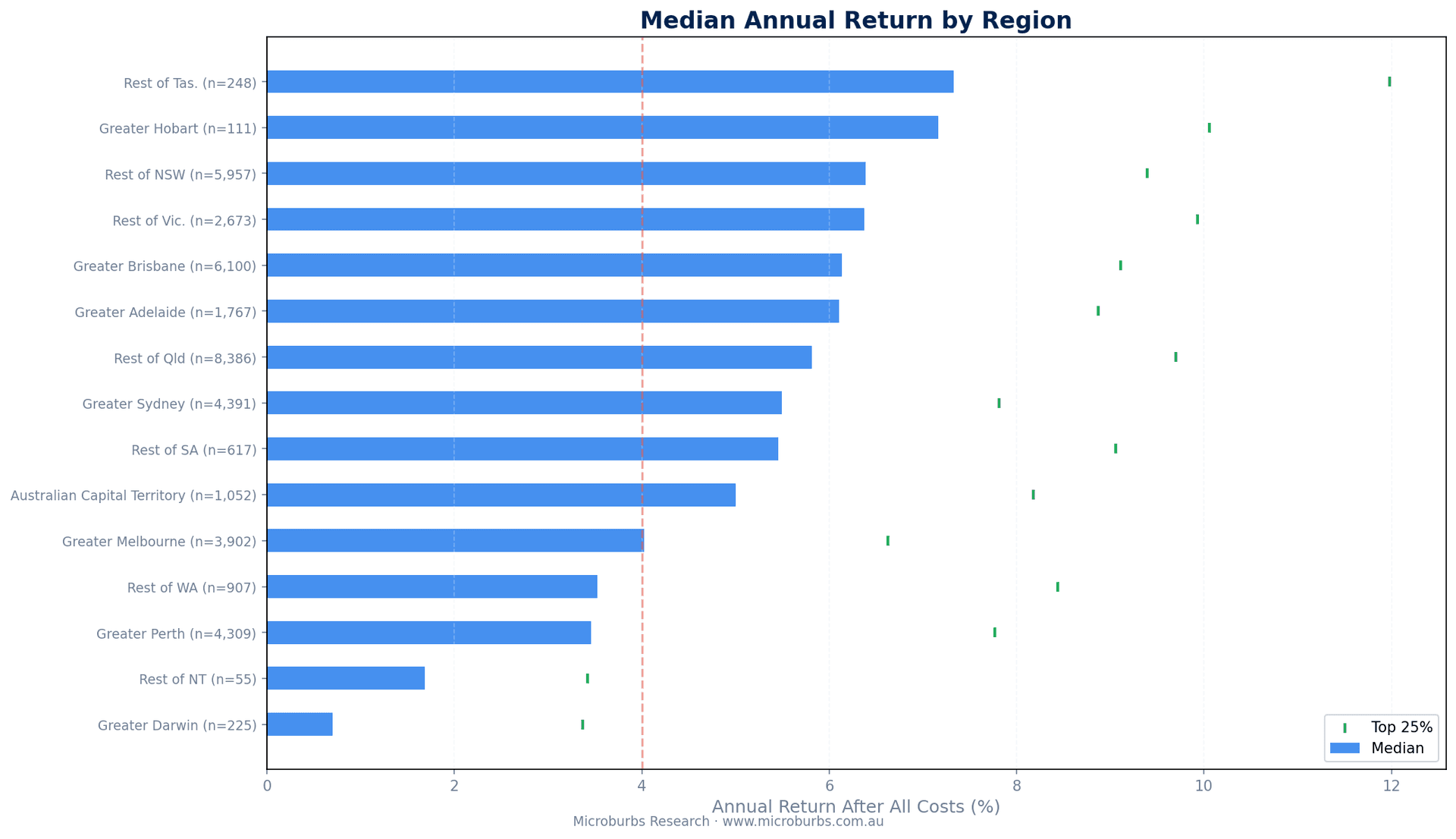
Which regions deliver the strongest returns? The answer is not what most investors expect.
Tasmania leads. Sydney sits in the middle. Melbourne and Perth trail. Darwin is nearly flat.
| Region | Median Annual Return |
|---|---|
| Rest of Tasmania | 7.3% |
| Greater Hobart | 7.2% |
| Rest of NSW | 6.4% |
| Rest of Victoria | 6.4% |
| Greater Brisbane | 6.1% |
| Greater Adelaide | 6.1% |
| Rest of QLD | 5.8% |
| Greater Sydney | 5.5% |
| ACT | 5.0% |
| Greater Melbourne | 4.0% |
| Greater Perth | 3.5% |
| Greater Darwin | 0.7% |
Tasmania dominates. Both regional Tasmania at 7.3% and Greater Hobart at 7.2% sit at the top. This reflects a period where Hobart went from Australia's most affordable capital to a mid-tier market. Investors who bought in Hobart around 2015 at $300,000 to $400,000 rode one of the strongest capital growth waves in recent memory.
Regional NSW and regional Victoria both outperformed their respective capitals. Greater Sydney returned 5.5%. Regional NSW returned 6.4%. That is not a small gap when compounded over a decade.
Greater Melbourne returned just 4.0%. Greater Perth returned 3.5%. Both suffered from extended flat periods. Perth had the mining downturn from 2014 to 2020. Melbourne had stamp duty increases and supply headwinds.
Greater Darwin at 0.7% is barely above zero. The median Darwin investor earned less than inflation after all costs. That is a loss in real terms.
The pattern:
The cheapest markets delivered the best returns during this period. Not because cheap always wins. But because cheap markets had the most room to re-rate when demand arrived. Tasmania, regional NSW, and Adelaide all followed this path.
How Long Should You Hold?
Is property a short game or a long game? The data says it depends on what question you are asking.
If you want the highest expected return, hold for 2 to 4 years. That bracket has a 6.9% median and an 83% profit rate. But it also has a bottom 10% of -2.1%. You could lose money.
If you want certainty, hold for 20 years. Every single investor in the 20+ year bracket made a profit. The worst of them earned 3.8% per year. But nobody in that bracket earned above 7.8%.
The profit rate climbs steadily with hold period. From 61% at under 2 years to 100% at 20+ years.
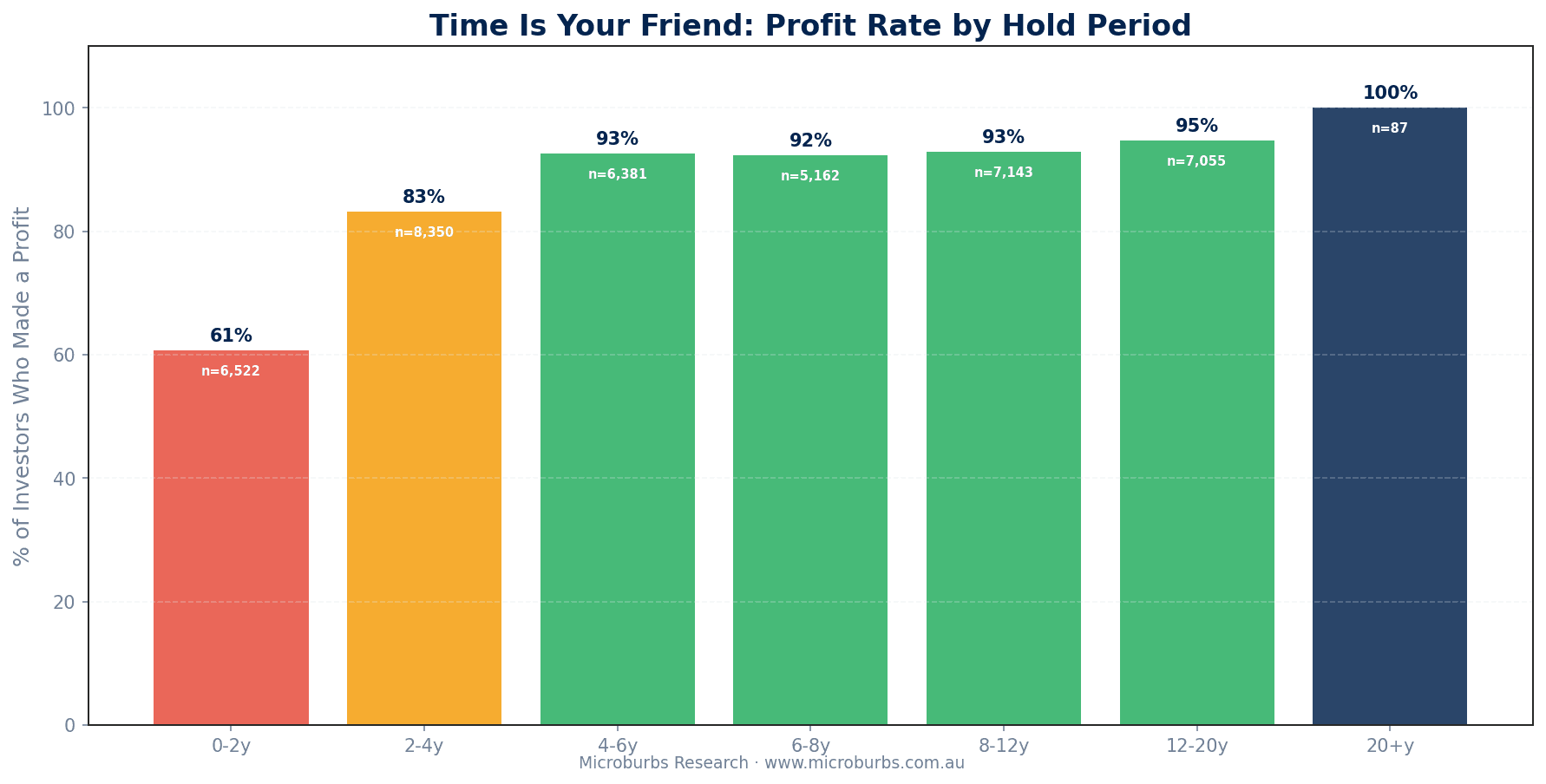
The 4-6 year bracket hits a sweet spot for many investors. The median is 6.7%, the profit rate is 93%, and the bottom 10% is still positive at 0.8%. You get most of the upside with much less downside than the short-term brackets.
There is a subtle point in this data that matters. The median return actually declines slightly for very long holds. 12-20 year holders earned a median of 4.8%, while 2-4 year holders earned 6.9%. This does not mean short holds are better. It means the cost drag of mortgage interest, maintenance, and management fees compounds over time. A property that doubles in 5 years looks spectacular. One that triples in 15 years delivers the same annualised return but pays 10 extra years of costs.
Time buys certainty, not higher returns. That trade-off is worth understanding before you commit.
Method
This study analysed 40,700 house transactions across Australia from 2002 to 2025. Each transaction represents a property bought and later sold by the same owner, allowing us to calculate the actual annualised return.
All costs were modelled at the individual transaction level. This includes state-specific stamp duty at purchase, mortgage interest on a principal-and-interest loan at 80% LVR, maintenance at 0.75% of purchase price per year, property management at 7% of rent, a 3% vacancy rate, selling agent fees at 2% plus marketing costs, and capital gains tax at the 50% discount rate with a 39% marginal tax rate. Depreciation (Division 43) and negative gearing tax benefits were also included. Land tax was excluded because a first investment property falls below the threshold in most states.
Properties that appeared to have been renovated were filtered out. Any property that sold for more than 3x the top-quartile price of its suburb in the year of purchase was excluded. This catches the pattern of buying a run-down property cheaply, renovating, and selling at a large multiple. The returns in this study represent organic capital growth and rental income, not renovation profit.
All returns are annualised using compound annual growth rate (CAGR) to allow comparison across different hold periods.
Limitations
- Houses only. This study covers freestanding houses. Units, townhouses, and apartments are not included. Their cost structure is different because of strata fees and body corporate levies.
- Sample period. The data spans 2002 to 2025. This period includes two major booms (2003-2007 and 2020-2022) and one major correction (GFC). Results may not represent future periods with different rate environments or supply conditions.
- Static rent assumption. Rental income was estimated based on suburb-level yields at the time of purchase. Rent changes over the holding period were not individually tracked for each property.
- Survivor bias potential. Properties that were demolished, subdivided, or converted to commercial use during the hold period may not appear as a standard resale in the dataset.
What This Means
Property works for most people. 86% of investors in this study made money. But 'most people make money' is a low bar. The question worth asking is: how do you land in the top quartile instead of the bottom one?
Three things stand out from the data.
Entry price matters more than location prestige. The top-performing suburbs all had median buy prices under $360,000. Cooee Bay, Elizabeth North, Murray Bridge. These are not glamorous markets. They are affordable ones. Investors who chased premium suburbs paid a premium that ate into their returns.
Hold period controls risk, not return. Holding longer does not increase your median return. It narrows the range of outcomes. If you need certainty, hold for 8 years or more. If you can stomach the variance, the 2-4 year bracket delivers the highest median. Know which game you are playing.
The gap between good and bad is enormous. At the 0-2 year mark, the top 10% earned 19.8% per year while the bottom 10% lost 23.5%. That is a 43-point spread. In the same market. During the same years. Selection is everything.
The property industry sells a narrative of inevitable wealth creation. The data tells a different story. Property can build wealth. It can also destroy it. The difference is not luck. It is research.
The median return of 5.5% per year is real. It is after every cost. But it is an average of vastly different outcomes, shaped by location, price point, and time horizon. Knowing where you sit in the distribution is more useful than knowing the median exists.
That is the kind of problem Microburbs was built to solve. Not 'what does the market do.' But 'what does this street, in this suburb, at this price point, do.' Hyper-local. Street-level. Tested.
Accessible Summary
Want the key findings without the technical detail?
Read the blog post with real suburb examples, simple charts, and practical takeaways for everyday investors.
Find Suburbs That Outperform
Microburbs analyses every street in Australia. See which pockets are undervalued and where the data points to growth.