
Why We Publish Weekly. And Why It Matters for Your Investment
By the time a monthly report hits your inbox, the hottest suburbs may have already peaked. Microburbs tracks investor search behaviour every week, so you can act on signals while they're still signals, not headlines.
Every Monday, Microburbs publishes a fresh ranking of the suburbs attracting the most investor research activity on our platform. Not every quarter. Not every month. Every week. That cadence is deliberate. It is the single most important feature of this report.
The Australian property investment landscape moves fast. A suburb can go from overlooked to oversaturated within six to eight weeks. A new infrastructure announcement, a media feature, or a viral social media post can shift search volumes dramatically in a matter of days. Monthly reports, by definition, can only tell you what was happening, not what is happening right now.
This week's data, covering the seven days from 17 Feb to 24 Feb 2026, illustrates exactly why the weekly cadence matters. One suburb went from being completely absent from our top 25 last week to claiming the number one position this week, with a rank change of positive 387. Another suburb has held a top-five position for thirty consecutive days, suggesting it has moved from emerging opportunity to established consensus. These are very different investment signals. You can only distinguish between them if you're watching every week.
Monthly reports are rearview mirrors. Weekly data is a windshield. Knowing the difference between a suburb that has just entered investor consciousness and one that has been in the top five for four weeks reveals how the market is thinking right now, not how it was thinking a month ago.
This Week's Biggest Story: Clyde North ▲387
If you were only reading a monthly report, Clyde North, in Melbourne's outer south-east growth corridor, would have barely registered on your radar last week. It wasn't in our top 25. This week, it is number one.
“Clyde North wasn't in the top 25 last week. This week it's #1, capturing 1.7% of all investor searches across the country in a single seven-day period.”
A rank change of positive 387 is not a marginal move. It signals a step-change in investor attention and reveals that something about Clyde North has caught the market's eye. The question for investors right now is: what is driving this sudden surge of interest?
Clyde North sits in the City of Casey, one of Australia's fastest-growing local government areas. The suburb is relatively young, with significant land releases still under way, which means stock availability remains reasonable at present. Infrastructure investment in the corridor (schools, retail, transport links) continues to mature. For investors who prefer to enter before a suburb becomes a household name in investment circles, a positive 387 rank change in a single week is the kind of early signal that is very difficult to catch unless you're reading weekly data.
The remaining top-five 7-day suburbs, Berwick (▲37), Alfredton (▼2), Point Cook (▲1), and Officer (NEW entry), round out a picture of Melbourne's south-east and outer west corridors dominating current investor search behaviour. Officer's appearance as a brand-new entry this week, with no prior ranking, echoes Clyde North's trajectory and is worth monitoring closely over the next two to three weeks.
When a suburb jumps from outside the top 25 to number one in a single week, it is one you something significant about where investor attention is shifting. Clyde North is at the very beginning of its investor attention curve. Whether that attention becomes sustained interest, or dissipates as quickly as it arrived, will be visible in next week's data.
Reading the 7-Day vs 30-Day Divergence
The most powerful analytical tool in this report is the comparison between the 7-day ranking and the 30-day ranking. These two tables tell fundamentally different stories, and the divergence between them is where the most actionable insight lives.
Here is the framework: a suburb that ranks highly on the 7-day table but does not appear in the 30-day top 10 has just entered investor consciousness. A suburb that sits at the top of the 30-day table but has slipped in the 7-day ranking has sustained attention but is now cooling relative to newer entrants. A suburb that appears in both tables simultaneously is a consistent performer. Demand has been building for weeks and shows no sign of abating.
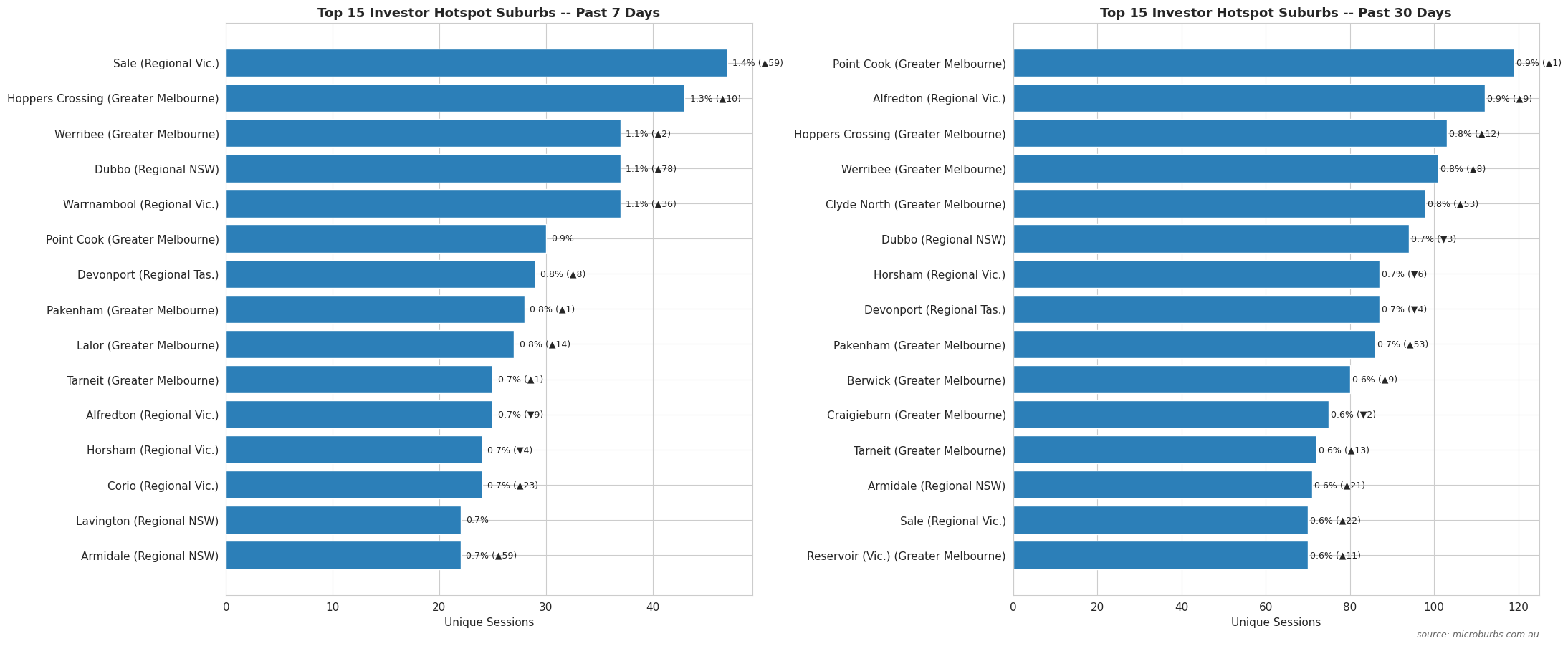
This week's data gives us three clear examples of each signal type:
7-day rank: #1. 30-day rank: #5. Absent from the top 25 just last week. This suburb has just entered the investor conversation. The opportunity window is open but may be brief.
30-day rank: #1. 7-day rank: #4. Point Cook has led investor searches for a full month. That sustained attention means more investors are already aware of it. Newer entrants are beginning to draw attention away.
7-day rank: #3. 30-day rank: #2. Alfredton in Ballarat has maintained a top-three position across both timeframes. This is not a flash of interest. It reflects deep, sustained investor conviction in the suburb.
The full 30-day top seven (Point Cook (#1), Alfredton (#2), Hoppers Crossing (#3), Werribee (#4), Clyde North (#5), Horsham (#6), and Devonport in Tasmania (#7)) tells a story of Melbourne's outer west corridor, regional Victoria, and regional Tasmania all competing for investor attention simultaneously. This breadth of geographic interest is itself a meaningful data point, which we will explore in the regional section below.
| 30-Day Rank | Suburb | Region | 7-Day Rank | Signal Type |
|---|---|---|---|---|
| 1 | Point Cook | Melbourne Outer West | #4 | Sustained / Cooling |
| 2 | Alfredton | Ballarat, Regional Vic | #3 | Consistent Performer |
| 3 | Hoppers Crossing | Melbourne Outer West | – | 30-Day Established |
| 4 | Werribee | Melbourne Outer West | – | 30-Day Established |
| 5 | Clyde North | Melbourne Outer South-East | #1 | Emerging – Watch Closely |
| 6 | Horsham | Regional Victoria | – | Regional Established |
| 7 | Devonport | Regional Tasmania | – | Regional Emerging |
Use the two tables together, not in isolation. The 7-day table identifies what's catching fire right now. The 30-day table identifies what has already been burning for a while. Cross-referencing the two is how you distinguish a genuine early opportunity from a suburb that the entire investment community has already discovered.
Fast Movers to Watch
Beyond the headline rankings, the week-on-week rank-change data surfaces a second tier of suburbs that deserve close attention. These are locations that have moved dramatically, often by hundreds of positions, in a single week. In many cases, they have only just entered the top 100, or even the top 200, for the first time. They are at the very earliest stage of the investor attention curve.
“Endeavour Hills moved up 420 positions in a single week. It wasn't being talked about in investment circles last Monday. It is this Monday.”
| Suburb | Region | 7-Day Rank Change | Notes |
|---|---|---|---|
| Endeavour Hills | Melbourne Outer South-East | ▲420 | Biggest mover of the week nationally |
| Sale | Gippsland, Regional Vic | ▲313 | Regional Victoria continuing to surge |
| Dandenong | Melbourne South-East | ▲306 | Affordability play in established corridor |
| Tarneit | Melbourne Outer West | ▲252 | Joins Point Cook corridor in search activity |
| Hampton Park | Melbourne Outer South-East | ▲217 | South-east corridor widening beyond Clyde North |
| Narre Warren | Melbourne Outer South-East | ▲154 | Established suburb seeing fresh interest |
| Lalor | Melbourne Northern | ▲144 | North corridor emerging alongside south-east |
Several patterns emerge from this table. First, Melbourne's outer south-east corridor is not a single-suburb story. Clyde North at number one is joined by Endeavour Hills (▲420), Hampton Park (▲217), and Narre Warren (▲154) as fast-rising search targets. Investors are scanning the entire corridor, not just its most-discussed postcodes. This broadening of geographic interest within a corridor is often a precursor to price competition spreading from the suburb that first attracted attention outward to its neighbours.
Second, the outer west corridor is widening as well. Tarneit's ▲252 move adds to the established presence of Point Cook, Hoppers Crossing, and Werribee in the 30-day table. And third, Sale's ▲313 move in Gippsland represents regional Victoria's continued expansion as an investor target. A theme we will return to shortly.
These fast-mover suburbs have not yet consolidated into sustained top-10 positions. They may or may not do so. But the data reveals where investor thinking is heading before it becomes common knowledge. The window between when a suburb first appears in the fast-movers list and when it becomes a fixture in the top-10 rankings is where the most useful market intelligence sits.
The fast-movers list is not a buy signal in isolation. It is a research prompt. When a suburb moves up 200 or 300 positions in a single week, the appropriate response is to start researching it immediately. Not to wait until next month when everyone else already has.
The Overheated Signal: Knowing Which Phase You're In
There is a corollary to the early-mover opportunity, and it is equally important for investors to understand. Just as weekly data helps you identify suburbs before the crowd, it also helps you identify suburbs where the crowd has already arrived.
When a suburb appears in the top 10 of both the 7-day and 30-day tables, and has been doing so for three, four, or five consecutive weeks, it is no longer an early opportunity. It is an established consensus trade. That does not make it a bad investment. But it does mean the risk profile has changed. More investors are already in the due-diligence phase. More buyers agents are already recommending it to clients. More media articles are already being written about it. By the time a suburb appears in a monthly report as a new hotspot, this stage has typically already been reached.
NEW entry this week with no prior ranking. First appearance in the top 25. Investor attention is just beginning. Early research window is now open.
Top 10 in both 7-day and 30-day rankings. Has held this position consistently. The investment community has been watching this suburb for weeks. Consensus has formed.
Officer, which entered this week's top five as a completely new entry, exemplifies the fresh-opportunity phase. No one has been writing reports about Officer for the past month. It appears for the first time this week. The investors researching it right now are, by definition, ahead of the consensus.
Horsham, by contrast, has been a fixture in the regional Victoria hotspot rankings for long enough that it is now well-covered territory. That does not mean Horsham is a bad investment. But the market is already well aware of Horsham. Most serious investors in the regional Victoria space have already formed a view and made their call.
The weekly cadence of this report gives you a precise window into which phase each suburb is in at any given moment. Monthly reports, by averaging across four weeks, obscure this distinction entirely. A suburb that was fresh in week one and established by week four looks identical in a monthly summary. But the market dynamics around each phase are very different.
The weekly report is not just a list of hot suburbs. It is a diagnostic tool for understanding which phase of the attention cycle each suburb is in. New entries and fast movers signal early opportunity. Multi-week top-10 fixtures signal established consensus. Use the report accordingly.
The Bigger Picture: Regional Australia Is Arriving
Stepping back from the individual suburb data, there is a structural shift visible in the broader search data that deserves its own discussion. Over the past twelve months, the share of investor searches directed at regional locations has undergone a significant and accelerating shift. We define regional here using the Greater Capital City Statistical Area (GCCSA) classification, which separates capital city suburbs from rest-of-state locations.
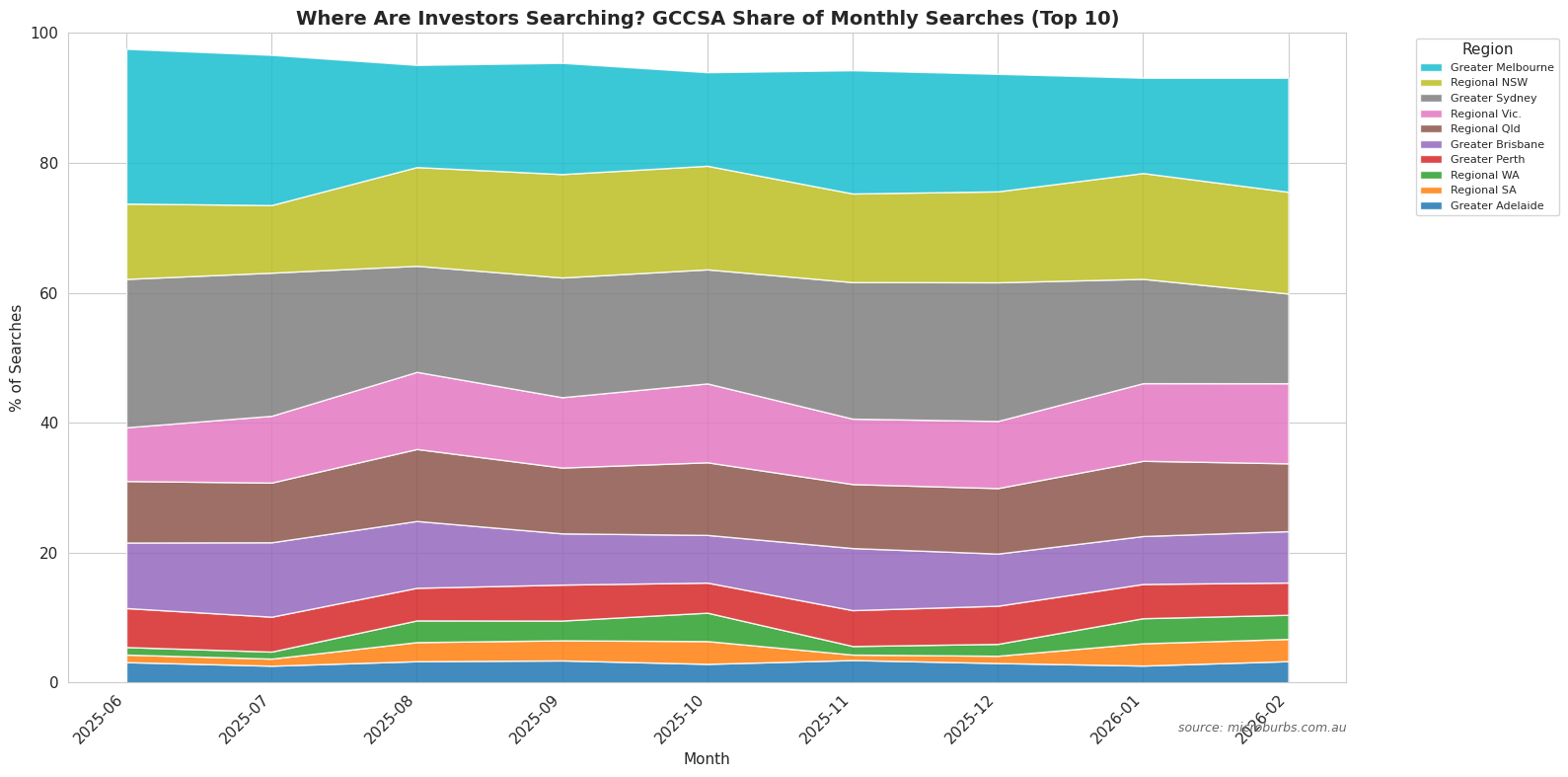
Regional Victoria's share of total investor searches has risen from 6.6% in February 2025 to 12.5% in February 2026. That is a near-doubling in twelve months. This is not a statistical blip. It reflects a sustained and accelerating reallocation of investor research attention away from capital city suburbs and toward regional centres. Alfredton (Ballarat), Sale (Gippsland), and Horsham (Wimmera) are all visible expressions of this trend in this week's data.
Regional Tasmania's trajectory is even more dramatic proportionally. From a base of 1.06% of national investor searches in February 2025, it has grown to 3.13% by February 2026. That is nearly triple in a year. Devonport's appearance in the national 30-day top seven is a direct reflection of this trend. Tasmania has historically been treated as a peripheral market by mainland investors. The data suggests that perception is changing.
The drivers of this shift are broadly consistent with what buyers agents operating in these markets have been observing on the ground: relative affordability versus capital city prices, improving rental yields as capital city rents have plateaued, and infrastructure investment in regional centres that is making them more viable for owner-occupiers, which in turn supports rental demand for investors. The weekly data allows us to track precisely how this structural shift is playing out at the suburb level in real time.
Regional Victoria and regional Tasmania are not fringe markets any more. They now represent a combined share of investor search activity that would have been inconceivable two years ago. The suburbs surfacing in this week's data (Alfredton, Sale, Horsham, Devonport) are early readings of a structural shift that is still accelerating. Monthly reports are only now beginning to reflect trends that weekly data first captured months ago.
Related Research
We Publish Every Monday
Bookmark this page and come back each week. The suburbs that top next week's list may not be anywhere near this week's rankings. That's exactly the point.