
Abstract
We analysed 4.6 million property transactions across all Australian states and territories from 2003 to 2026. The question: does affordability at purchase predict which properties beat the market?
A simple price-to-income ratio captures part of the effect. The Microburbs Affordability Index goes further, decomposing income and adding neighbourhood factors. It separates winners from losers 1.7 times more effectively.
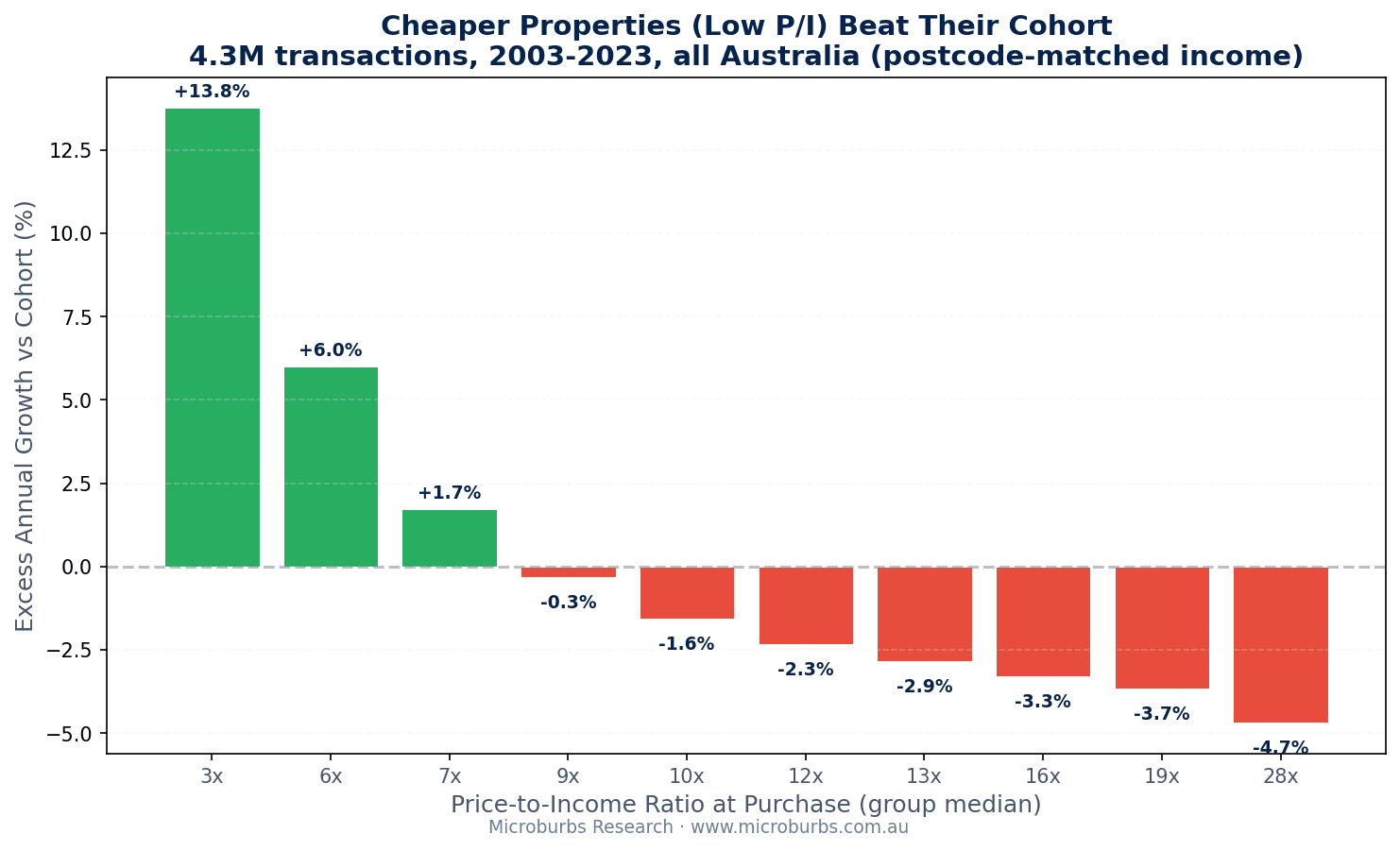
After controlling for timing, we find a consistent relationship. Properties purchased at low price-to-income ratios outperformed. Those purchased at high ratios underperformed. This held across every capital city, for both houses and units, and at every price point from 2003 to 2026. The cheapest 10% beat their timing group by more than 12% per year. The most expensive 10% trailed by roughly 4.5% per year.
Contents
Key Findings
- The Microburbs Affordability Index is the strongest predictor of whether a property beats its cohort over the following hold period (2003-2026).
- The Microburbs Affordability Index identifies outperformers 1.7 times more effectively than a simple price-to-income ratio (30 percentage point spread vs 17 points, 2003-2026).
- Properties in postcodes scoring 80 or above outperformed their group of properties bought and sold in the same years by more than 5 percentage points per year from 2003 to 2026.
- Properties in postcodes scoring below 20 trailed their cohort by more than 4 points per year over the same period.
- The breakeven sits at a score above 50 on the Microburbs Affordability Index. Above that, you tend to beat the market. Below it, you tend to trail.
- The effect is strongest in owner-occupier areas. Affordable suburbs with low investor presence outperformed their cohort by roughly 6 points per year from 2003 to 2026.
- Supply pressure does not moderate the effect. Affordable properties outperform regardless of new housing supply.
- The relationship holds in every capital city, with the strongest signal in Darwin and Adelaide and the weakest (but still statistically significant) in Sydney.
The Four Affordability Zones
The Microburbs Affordability Index scores every postcode from 1 to 100. It combines the price-to-salary ratio with 100 other factors including welfare dependency, investor activity, local employment mix, and neighbourhood characteristics. A score of 80 or above means the area's affordability profile has historically been associated with outperformance.
Based on the relationship between the Index score at purchase and subsequent excess returns from 2003 to 2026, we define four zones:
These zones are not absolute rules. They describe a statistical tendency observed across millions of transactions. Individual properties can outperform at any score level if they have other advantages (location quality, development potential, renovation upside). But across 166 monthly backtests from 2010 to 2023, higher-scoring areas outperformed in every single month tested.
Methodology
We examined every property in Australia that was purchased and subsequently resold between January 2003 and December 2026. For each property, we calculated the annual compound growth rate over its hold period. We then grouped all properties by their purchase year and sale year, creating 231 group of properties bought and sold in the same yearss. Each property's excess growth is simply its individual growth rate minus the average growth rate of all properties bought and sold in the same years.
This design removes the effect of market cycles. A property bought in 2015 and sold in 2020 is compared only to other properties with the same timing. The question becomes: among all properties traded in the same window, which ones did better?
For each property, we recorded the price-to-income ratio at the time of purchase by matching the purchase price to the median annual income of the suburb in the purchase year. Income data is drawn from proprietary income data matched to the purchase year.
The full dataset contains 4.6 million repeat-sale transactions across all Australian states and territories from 2003 to 2026. Of these, 97% had reliable income matching using granular income data and form the basis of the analysis. Properties with extreme growth (more than doubling or losing more than half their value per year) were excluded.
Results
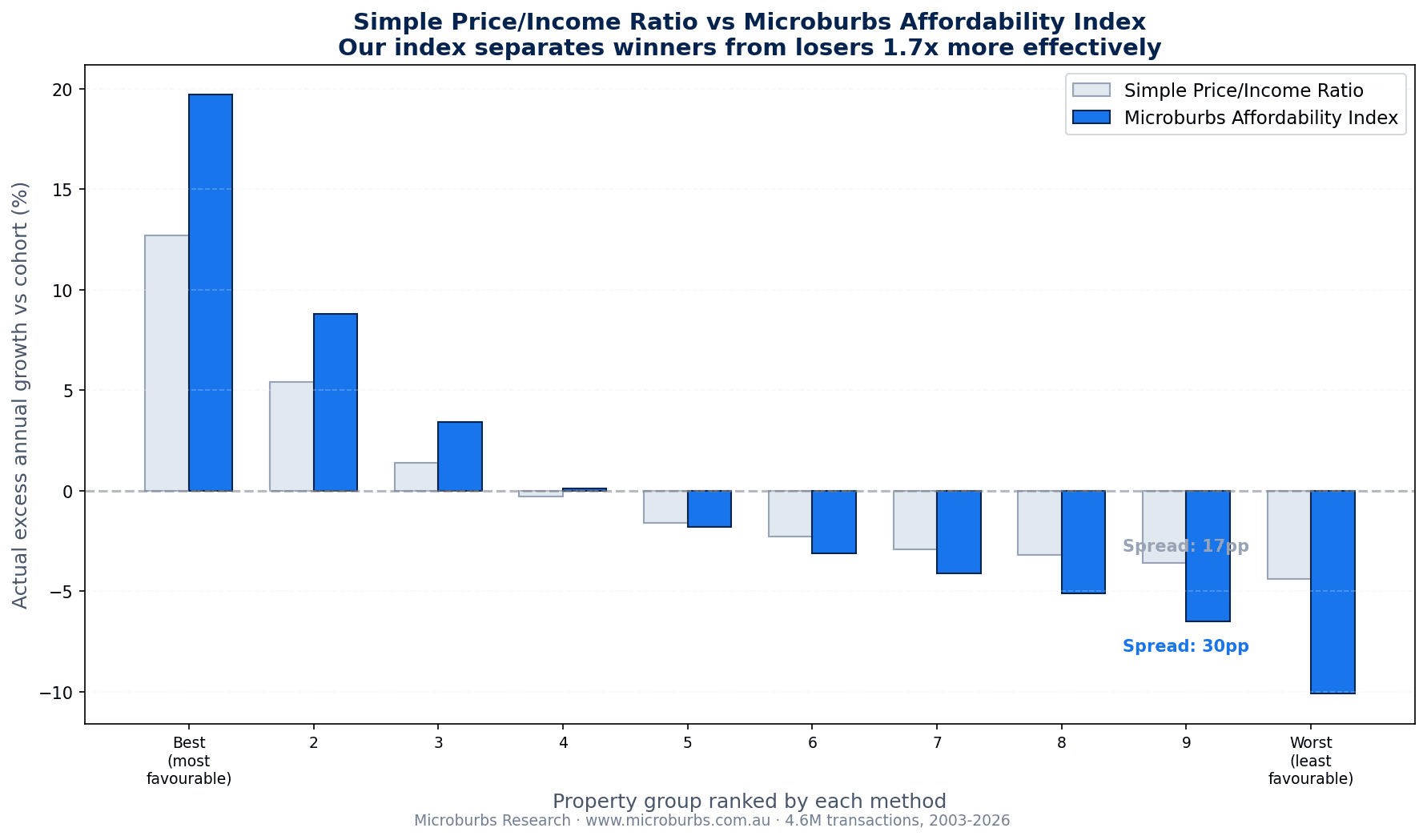
A simple price-to-income ratio is a good start. Anyone can calculate it. But it only tells part of the story. The Microburbs Affordability Index goes deeper: it breaks income into salary, business, investment, and welfare components, accounts for investor activity and welfare dependency, and considers 100 neighbourhood factors. The result? A spread of 30 percentage points per year between the top and bottom groups (2003-2026), compared to 17 points for the simple ratio. That is 1.7 times more separation between winners and losers.
The pattern is consistent across every group, with no reversals. Every step up the price-to-income ladder comes with lower excess returns. No reversals across the 10 groups from 2003 to 2026. The cheapest decile (median P/I of 4 times income) outperformed its cohort by more than 12 points per year from 2003 to 2026. The most expensive decile (median P/I of 43 times income) trailed by about 4.5 points.
By Capital City

| City | Transactions | P/I Effect Strength |
|---|---|---|
| Darwin | 12,943 | Very strong |
| Hobart | 18,326 | Very strong |
| Adelaide | 170,145 | Strong |
| Perth | 353,921 | Strong |
| Regional Australia | 1,557,270 | Moderate |
| Melbourne | 437,836 | Moderate |
| Brisbane | 216,598 | Moderate |
| Sydney | 423,182 | Present but weaker |
To illustrate: in Tapping (Perth), 1,464 properties traded from 2003 to 2026 with a median P/I of 31 times income. These properties collectively beat their group of properties bought and sold in the same years by more than 20 points per year on average. In contrast, properties in Wentworth Point (Sydney) (2,424 transactions, median P/I of 20 times income) trailed their cohort by roughly 7 points per year over the same period.
Houses vs Units

For houses, the cheapest quintile outperformed by more than 9 points per year from 2003 to 2026, while even the most expensive quintile roughly matched its cohort. For units, the cheapest quintile outperformed by about 3 points, but the most expensive quintile trailed by 4 points. The lesson: houses bought cheaply have the most upside. Units bought expensively carry the most risk.
The Owner-Occupier Sweet Spot
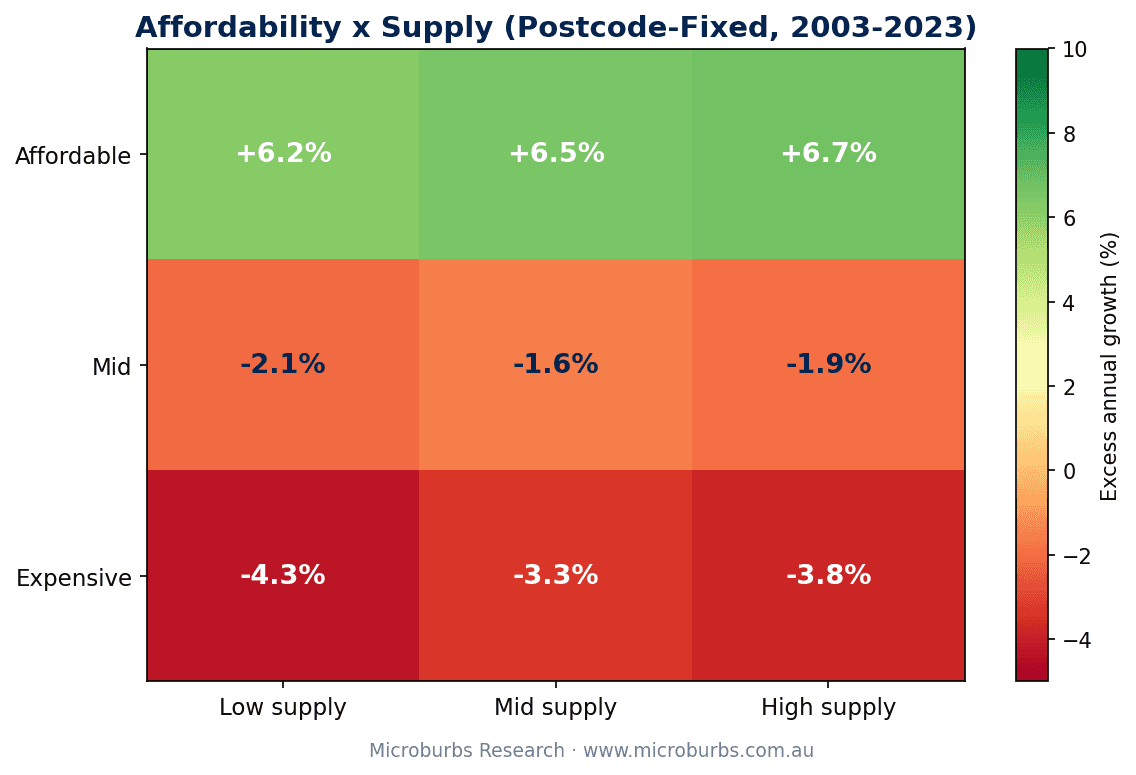
Affordable properties in areas with low investor presence outperformed their group of properties bought and sold in the same years by roughly 6 points per year from 2003 to 2026. This was the strongest combination in the dataset. The likely explanation: owner-occupier-dominated areas have less speculative demand, so prices better reflect genuine housing need. When incomes rise in these areas, prices follow.
Defence Against Criticism
"You are just measuring price correction toward long-run averages"
Partly. Mean reversion is part of the mechanism. But the finding goes further: the relationship is not symmetric. The upside from buying cheaply (more than 12 points per year excess in the lowest decile from 2003 to 2026) is far larger than the downside from buying expensively (about 4.5 points in the highest decile). If this were pure price correction toward long-run averages, the magnitudes would be roughly equal. The asymmetry suggests that affordable properties capture genuine demand-driven growth, not just statistical bounce-back.
"Local income data is unreliable"
Our income data provides broad geographic coverage. Approximately 3% of properties could not be reliably matched to income data and were excluded from the analysis. The results are based on the 4.6 million transactions with valid income matching, representing 97% of the full dataset.
"The census and area data may not reflect conditions at purchase"
Neighbourhood characteristics are time-matched where annual data is available. Income data is matched to the purchase year using annual income data. For census-derived features (available every five years), we use the nearest preceding census.
Limitations
- This analysis covers completed sales only. Properties still held are not included, which may introduce selection towards properties that were resold.
- Income matching relies on income data. Roughly 3% of transactions were excluded due to missing income data.
- Past performance does not guarantee future results. The 23-year relationship may weaken if market dynamics change.
Conclusion
The Microburbs Affordability Index is among the strongest predictors of excess property returns in Australia over the last two decades. The relationship is monotonic, holds in every capital city, for both houses and units, and at every price point. It survives after controlling for timing cycles and relies primarily on information available at the time of purchase.
What this means for buyers: check the Index score for the postcode where you are buying. Score above 50, lean in. Above 80, strongly favour. Below 20, you are fighting a statistical headwind.
This is not a guarantee. Individual properties can defy the trend. But across 4.6 million transactions and 23 years of data, the pattern is clear and consistent. Affordability at the point of purchase is not just a measure of risk. It is a measure of opportunity.