
Suburb Forecasting Model: Backtesting Results
Walk-forward backtesting from 2008 to 2024 across 6,320 Australian suburbs. All growth figures are relative to the national average.

Outperformance vs the National Average
Each month, the model ranks every suburb by predicted 2-year capital growth for houses. Growth is measured relative to the national average. A score of +7% means that suburb grew 7 percentage points faster than the national average over 2 years.
Over the full backtest, the top 5 picks averaged +7.2% outperformance per 2-year forecast. The top 20 averaged +6.2%. The latest 12-month rolling average for the top 20 sits at +8.0%.
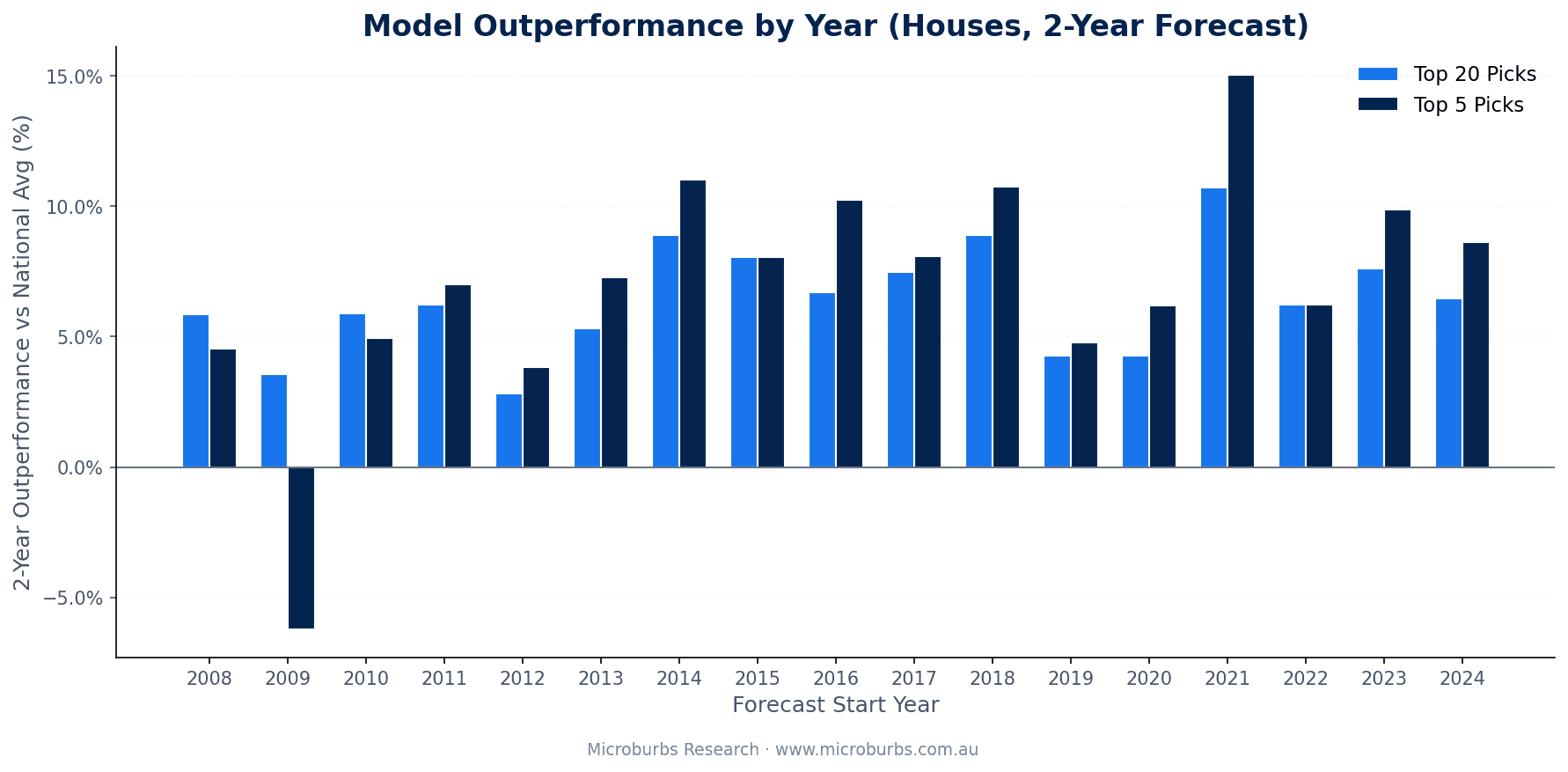
2-year outperformance vs national average for top 5 and top 20 picks, by forecast start year.
Key finding: The top 20 picks outperformed the national average in every single year from 2008 to 2024. The strongest year was 2021 at +10.6% (top 20) and +15.0% (top 5). Even during the weak 2012 period, top 20 picks still beat the national average by +2.9%.
Rolling Outperformance Over Time
The rolling 12-month average shows the stability of the model's outperformance. It captures how the signal evolves across different market conditions, from the GFC through the COVID boom and the subsequent correction.
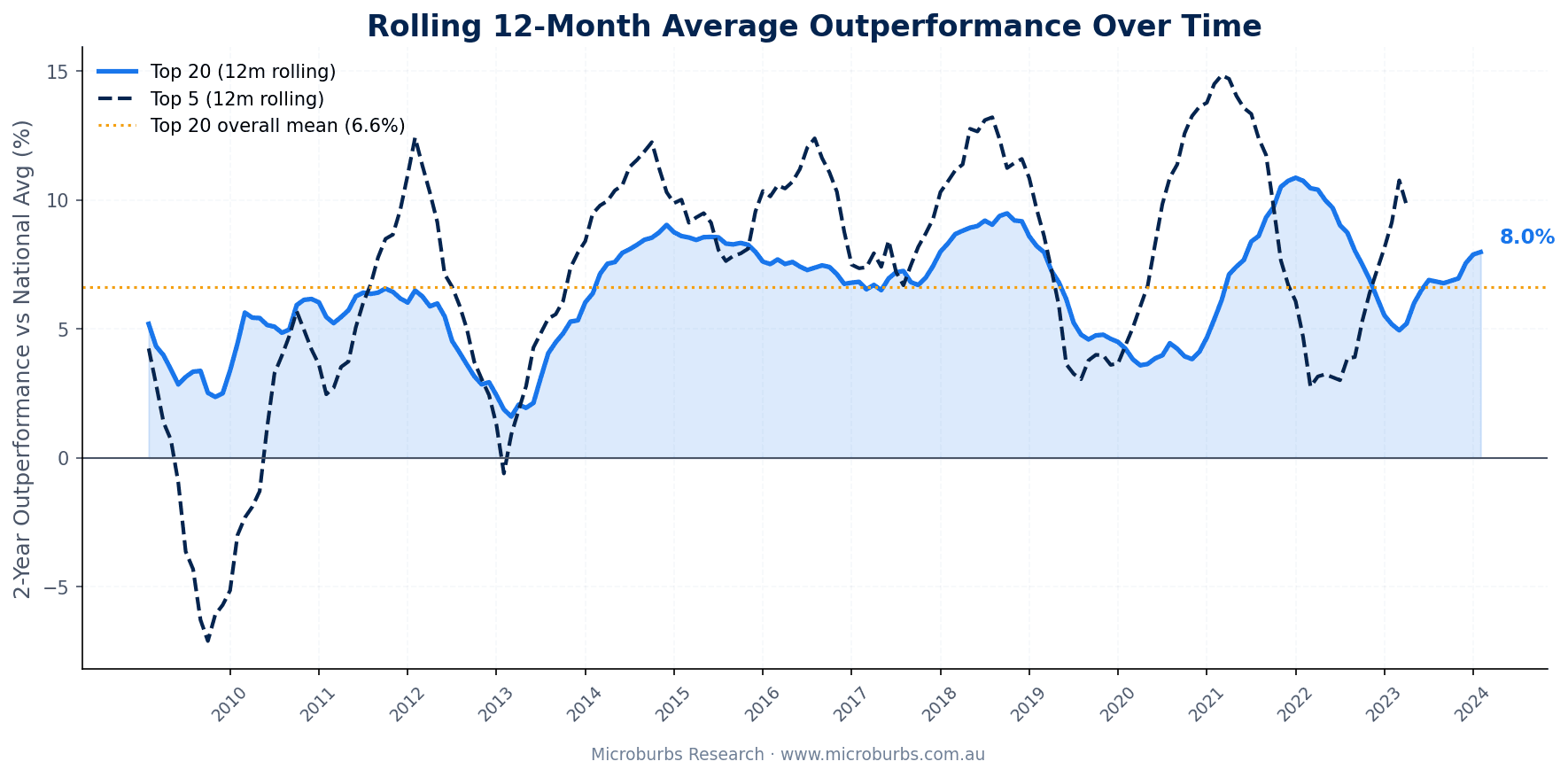
Rolling 12-month average of 2-year outperformance vs national average. The dashed gold line is the overall mean (+6.6%).
Key finding: The rolling outperformance stayed positive for the vast majority of the 17-year period. Brief dips below zero occurred during sudden market shifts, but the model recovered quickly each time. The latest reading is +8.0% for the top 20.
Ranking Signal Across All Deciles
The model's signal is not limited to the top picks. We split all 6,320 suburbs into 10 equal groups by rank each month and measured the average 2-year growth relative to the national average within each group.
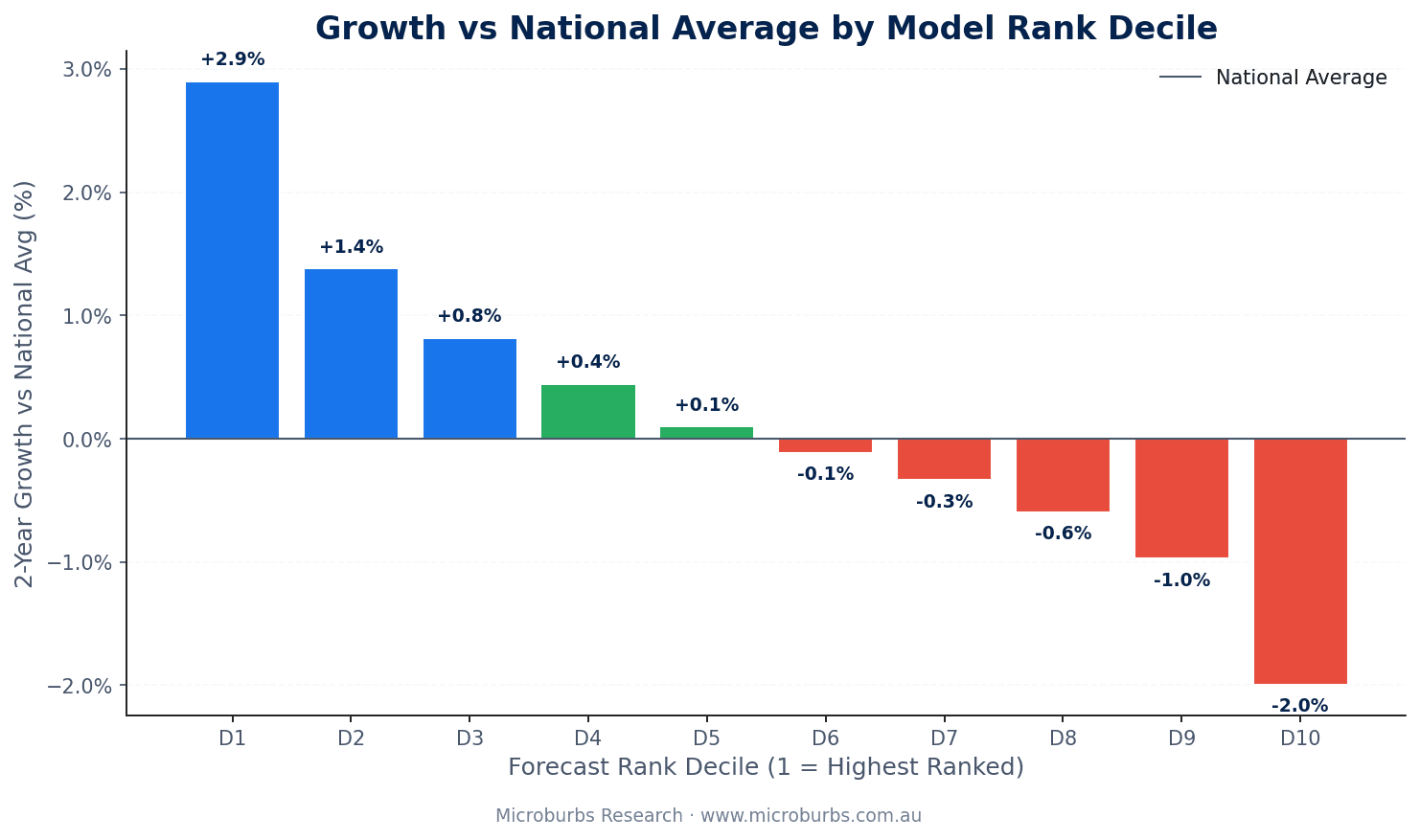
Average 2-year growth vs national average by model rank decile. The zero line represents the national average.
Key finding: The staircase is monotonic. The top decile outperformed by +2.9%, while the bottom decile underperformed by -2.0%. The spread between top and bottom is 4.9 percentage points. This pattern confirms the model carries genuine predictive signal across the full distribution.
Cumulative Outperformance
If you had followed the model's top 20 picks each year and compounded the excess return above the national average, here is how a $100,000 starting portfolio would have grown relative to one tracking the national average.
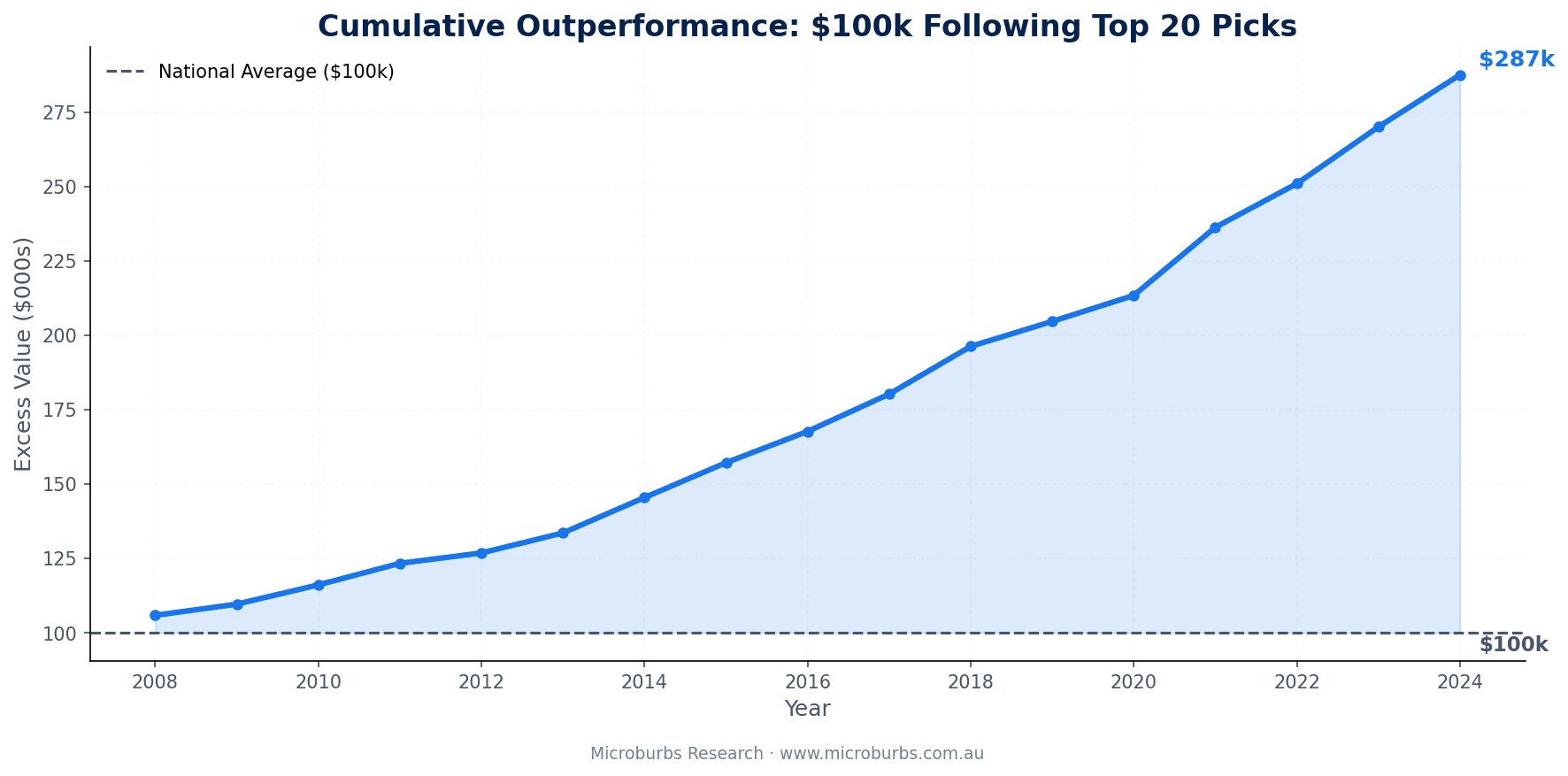
Cumulative excess value of $100k following top 20 picks vs national average, compounded annually from 2008.
Key finding: $100,000 compounding at the top 20's excess return grew to $287,000, nearly triple the national average baseline. The outperformance accelerated from 2014 onward as the model's signal strengthened across multiple market cycles.
Hit Rate
The hit rate measures the percentage of top 20 picks that beat the median suburb in their forecast period. A random model would achieve 50%.
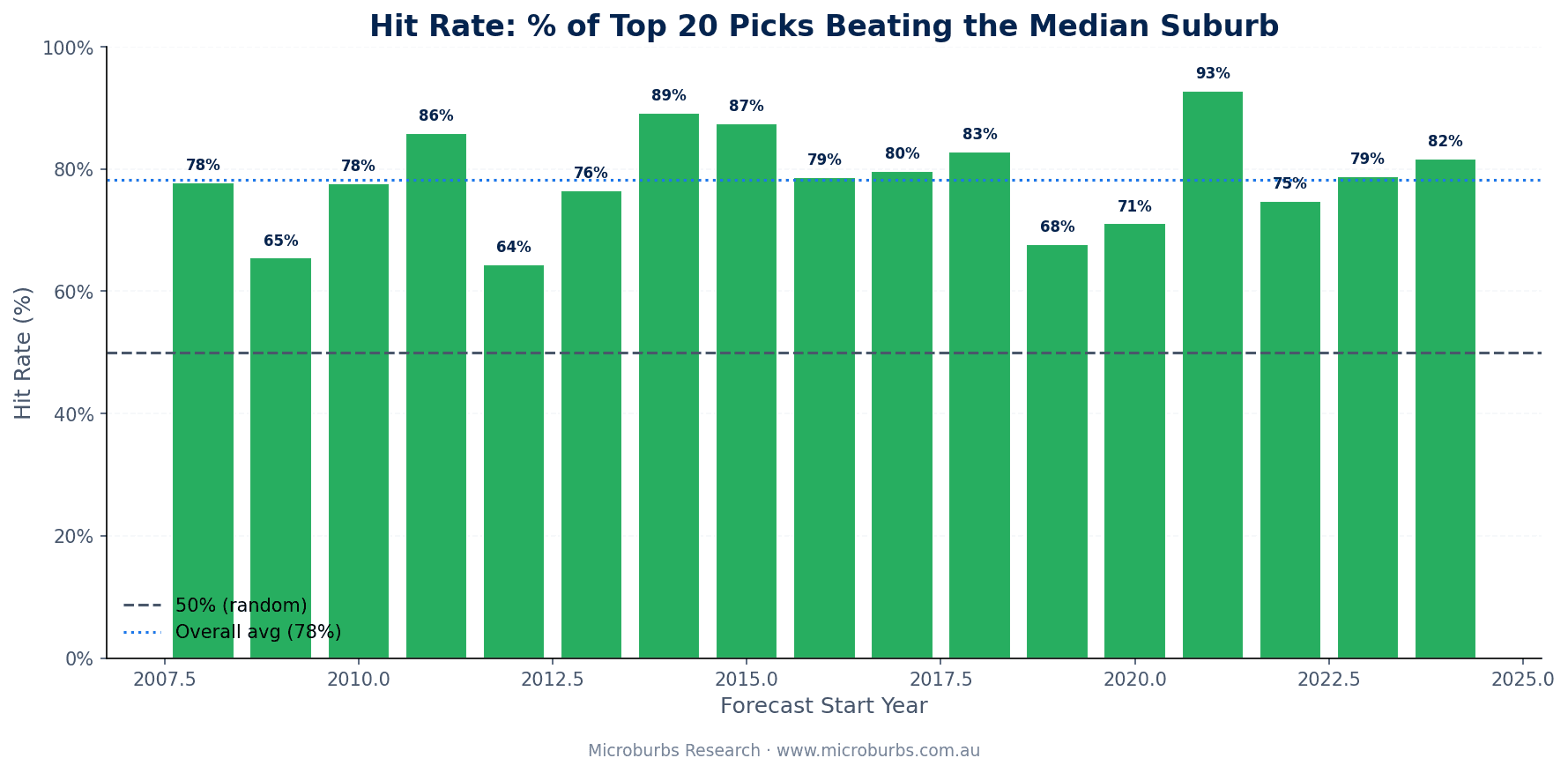
Percentage of top 20 picks outperforming the median suburb, by forecast start year.
Key finding: The overall hit rate is 78%. The model exceeded 50% in every year. The best year was 2021 at 93%. Even the weakest (2012, 64%) cleared the random baseline by 14 percentage points.
Forecast Accuracy
The mean absolute error (MAE) measures how far the model's point estimates deviate from actual outcomes, averaged across all suburbs.
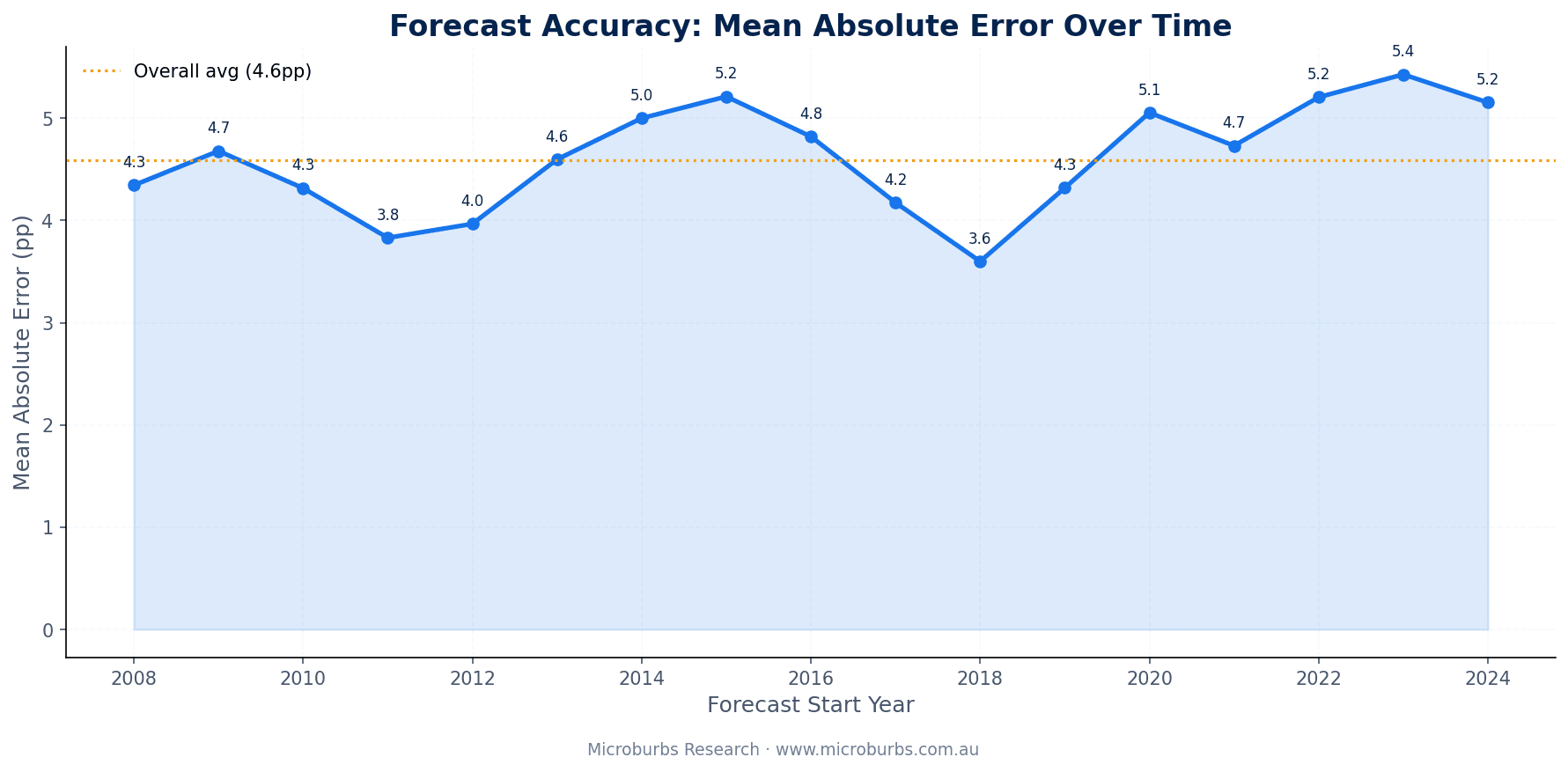
Mean absolute error of 2-year house forecasts by year. Lower is better.
Key finding: The overall MAE is 4.6 percentage points. The most accurate year was 2018 (3.6pp). Recent years show slightly higher errors (5.2-5.4pp), reflecting COVID-era market volatility.
Outperformance by State
The model ranks suburbs nationally. This chart shows how the top 20 picks performed within each state.
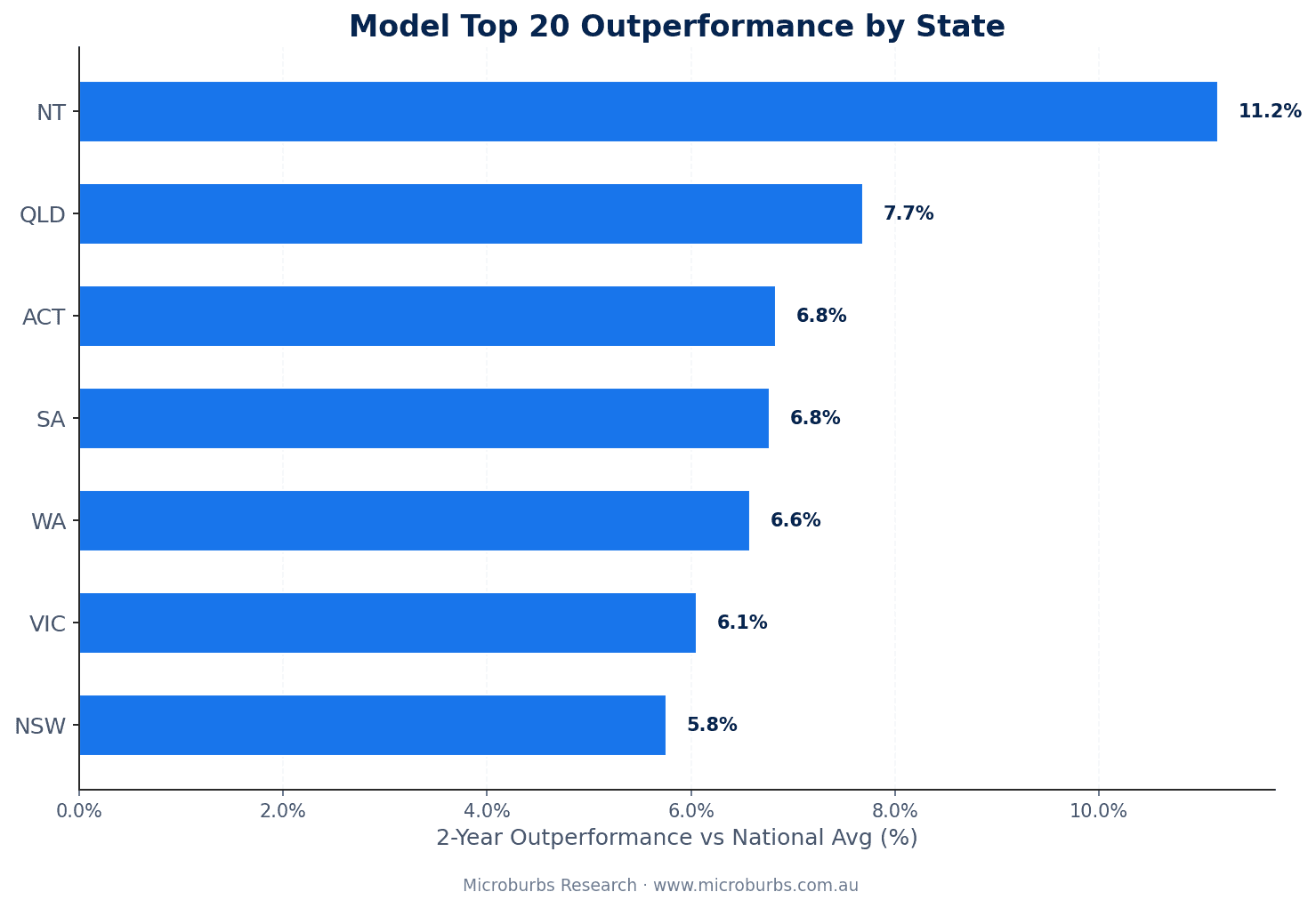
Top 20 outperformance vs national average by state.
Performance by Property Type and Horizon
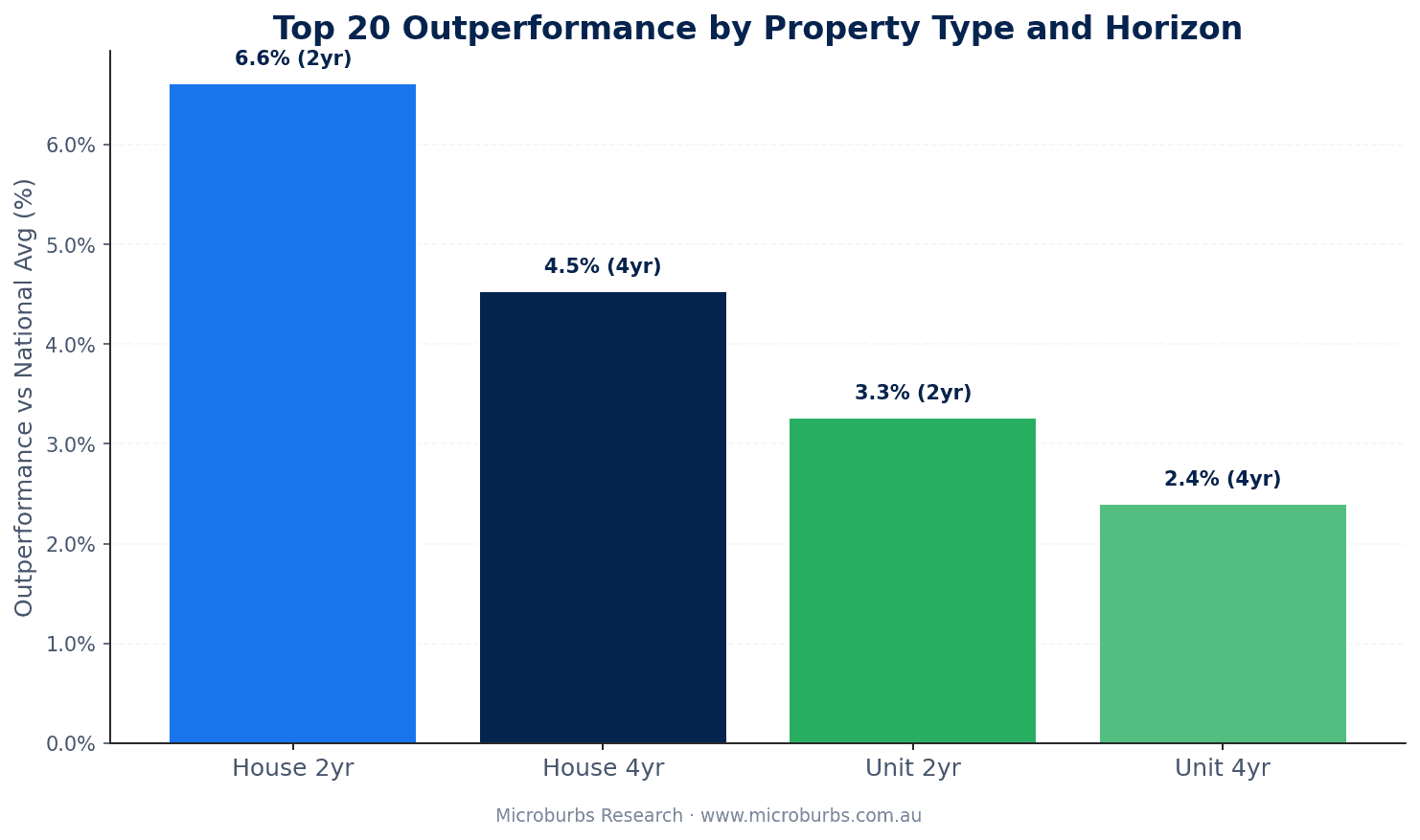
Top 20 outperformance by property type and forecast horizon. Growth is relative to the national average for each category.
Key finding: House 2-year forecasts produce the strongest signal at +6.2% outperformance. Houses at the 4-year horizon show +5.6%. Units also show positive outperformance at +2.8% (2yr) and +4.0% (4yr).
Summary Statistics
| Metric | House 2yr | House 4yr | Unit 2yr | Unit 4yr |
|---|---|---|---|---|
| Top 20 outperformance (2yr) | +6.2% | +5.6% | +2.8% | +4.0% |
| Top 5 outperformance (2yr) | +7.2% | - | - | - |
| Latest rolling 12m (top 20) | +8.0% | - | - | - |
| Hit rate (top 20 vs median) | 78% | - | - | - |
| MAE (all suburbs) | 4.6pp | - | - | - |
| CI coverage | 78.3% | - | - | - |
| Backtest period | Mar 2008 - Feb 2024 | |||
| Suburbs tested | 6,320 | |||
Yearly Detail (Houses, 2-Year)
| Year | Top 20 | Top 5 |
|---|---|---|
| 2008 | +5.8% | +4.6% |
| 2009 | +3.6% | -5.8% |
| 2010 | +5.9% | +5.0% |
| 2011 | +6.2% | +6.3% |
| 2012 | +2.9% | +3.9% |
| 2013 | +5.3% | +7.1% |
| 2014 | +8.8% | +10.9% |
| 2015 | +8.1% | +8.1% |
| 2016 | +6.7% | +8.2% |
| 2017 | +7.5% | +8.2% |
| 2018 | +8.9% | +10.6% |
| 2019 | +4.3% | +4.8% |
| 2020 | +4.3% | +4.3% |
| 2021 | +10.6% | +15.0% |
| 2022 | +6.2% | +6.1% |
| 2023 | +7.5% | +9.9% |
| 2024 | +6.4% | +8.5% |
Methodology
Walk-forward backtesting of the Microburbs suburb capital growth forecasting model.
- Model: Random Forest (max depth 6) trained on hedonic price index features from the Smart Fusion system.
- Walk-forward design: Retrained on a rolling 5-year window. At no point does the model access future data.
- Training windows: Three cut-offs (2006, 2011, 2016) producing forecast periods from 2008 through 2024.
- Universe: 6,320 SAL-level suburbs, excluding supply-constrained markets.
- Growth measure: Hedonic price index growth relative to the national average, measured over 2-year and 4-year horizons.
- Outperformance: exp(mean(y)) - 1, where y is the log growth relative to the national average.
Limitations: This is a backtesting exercise. Past performance does not guarantee future results. Transaction costs are not included. The top 20 universe changes monthly and may include suburbs with limited liquidity.
See the Latest Suburb Forecasts
Access the model's current top-ranked suburbs, updated weekly.